Fedora Linux 45 Debuts With Stricter Package Security and Expanded Storage Options
Following two weeks of release postponements, the Red Hat-backed operating system ships with mandatory RPM signature checks and installer support for Stratis storage.
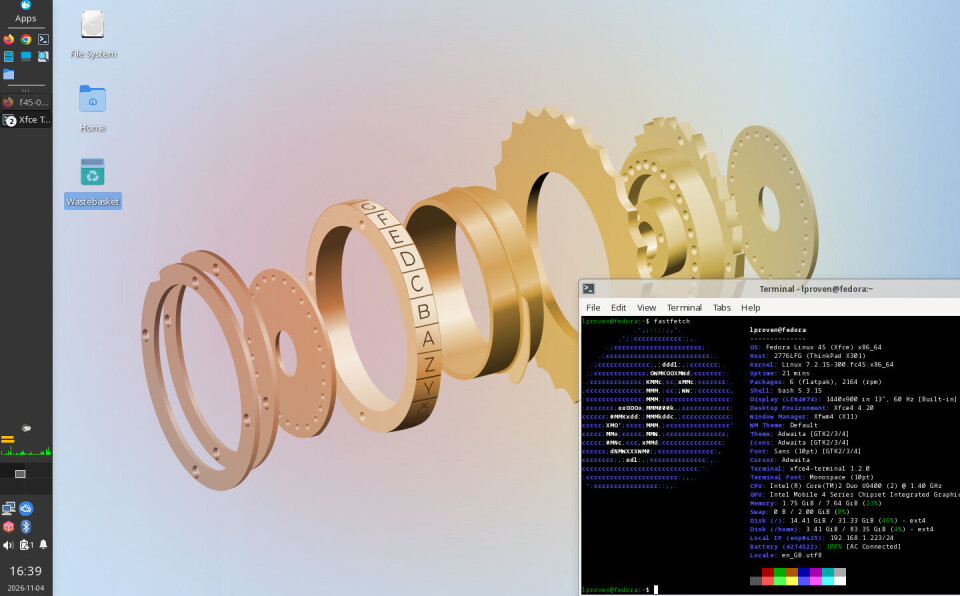
The Red Hat-backed Fedora Project released Fedora Linux 45 for general availability on Tuesday, delivering the latest iteration of its open-source operating system following two consecutive one-week release delays caused by late-stage validation issues.
The release serves as an essential indicator for enterprise Linux development, functioning as the primary upstream pipeline for technologies destined for future releases of Red Hat Enterprise Linux. In an announcement published by Red Hat, Fedora Project Leader Jef Spaleta highlighted a series of architectural modernizations across system security, core developer toolchains, and container workflows.
A central architectural shift in Fedora 45 is the transition to RPM version 6.1, which enables mandatory package signature verification by default. The update requires all incoming packages to feature cryptographically verified signatures before installation unless users explicitly override the policy, and it prevents unauthorized, silent alterations of package vendors. The project has also integrated the Sequoia OpenPGP implementation to modernize cryptographic validation.
System security has been further tightened by restricting kernel process tracing (ptrace) for unprivileged accounts to stop local malware from snooping on neighboring tasks, with tracing automatically restored when system diagnostic packages are loaded. On the desktop, credential handling transitions to the oo7 secrets management service across GNOME and KDE Plasma environments.
The flagship workstation edition incorporates the GNOME 51 desktop environment, while the secondary primary spin packages KDE Plasma 6.8. Both flagship editions now run exclusively on the Wayland display protocol, though as noted in reporting by The Register (https://www.theregister.com/os-platforms/2026/11/04/fedora-45-is-finally-finished-and-fit/5307631), traditional X11 windowing support remains available across seven alternative spins, including Xfce, MATE, Cinnamon, and i3. Workstation 45 also introduces encapsule, a new command-line tool enabling software developers to isolate untrusted scripts inside containers rather than executing them on the host operating system.
Fedora 45 expands storage configurations by adding native installation support for Red Hat's Stratis storage subsystem, shipping version 3.9.3. First introduced as an experimental technology in Fedora 29, Stratis acts as an open-source, GPL-licensed alternative to OpenZFS by unifying the XFS filesystem, LVM logical volume management, and Linux device-mapper capabilities to offer automated volume growth and copy-on-write snapshotting. For custom drive layouts, the Anaconda installer can now launch the Cockpit web interface directly.
For specialized hardware, the release is accompanied by Fedora Asahi Remix 45, which brings preliminary support for Apple's M3 family of chips alongside existing M1 and M2 compatibility, though M3 Ultra systems remain unsupported for now.
Due to the distribution's deployment delays, Fedora 45 arrives running the 7.2.15 Linux kernel—a revision that kernel maintainer Greg Kroah-Hartman designated as the final end-of-life build for the 7.2 branch on November 1. However, Fedora's routine distribution of non-isolated kernel upgrades means production systems are expected to transition to the newer kernel 7.3 branch in early post-release updates.
Under the hood, the release updates core developer tooling to GCC 16.2, glibc 2.44, LLVM 23, and Go 1.27, while deprecating unmaintained VPN packages for vpnc and Fortinet SSL connections. Minimum recommended system requirements are now set at a 2 GHz quad-core processor, 8 GB of system memory, and 20 GB of local storage.
Sources
Written by
The Company Wire
Inside the companies building what’s next. Reporting on startups, technology, funding and the people shaping them.

