US Space Force Decommissions Decades-Old Missile Warning Satellite Network
The military officially retired its legacy Defense Support Program after raising its final two early-warning satellites into graveyard orbits.
The U.S. Space Force has officially decommissioned its legacy Defense Support Program, ending more than 55 years of orbit-based missile detection that originated during the Cold War, according to reporting by Ars Technica (https://arstechnica.com/space/2026/10/us-military-ends-long-running-program-to-spot-nuclear-missile-launches/).
The military service confirmed the retirement after the final two operational satellites, presumably DSP-20 and DSP-22, completed on-orbit maneuvering exercises in early September. Independent orbital tracking showed both spacecraft subsequently raised their altitudes by several hundred kilometers, transferring them into graveyard orbits above geostationary space.
"The DSP constellation was foundational to the defense of our nation," said US Space Force Col. Brandon Davenport, Mission Delta 4 Commander. "These last two satellites were the culminating end to over a half century of space-based early warning. The DSP constellation ensured deterrence during the Cold War and protected our deployed warfighters from the Gulf War until their retirement last month."
The program began in November 1970 with a classified payload launched aboard a Titan IIIC rocket from Space Launch Complex 40 at Cape Canaveral Air Force Station, which has since been renamed Cape Canaveral Space Force Station. Operating in geosynchronous orbit, the initial series of satellites built between 1970 and 1973 weighed approximately one metric ton each and carried around 2,000 infrared detectors to spot Soviet intercontinental ballistic missile launches.
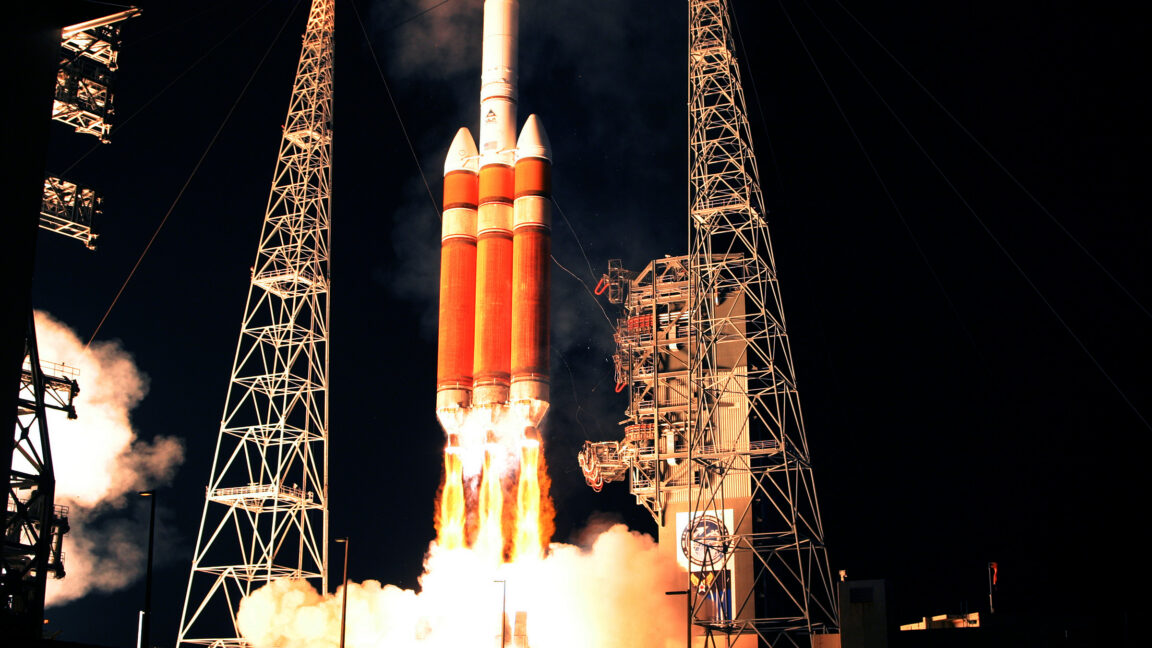
Over subsequent decades, the constellation expanded in both capability and mass. Later spacecraft weighed roughly 2.5 metric tons and housed more than 6,000 infrared detectors. Constellation launches continued through 2007 across several launch systems, including Titan variants, the Delta IV Heavy, and NASA's Space Shuttle Atlantis, which carried the DSP-16 payload in 1991. In addition to strategic nuclear deterrence, the system provided operational early warning during conventional conflicts, including the detection of Iraqi Scud missile launches.
The program's history also traced wider industry transitions. Following the conclusion of Titan launches from Space Launch Complex 40 in 2005, the U.S. Air Force awarded the launch pad to SpaceX in a competitive process opposed by United Launch Alliance.
Missile warning duties have already shifted to newer orbital hardware. The military began launching the Space Based Infrared System in 2011, incorporating more sensitive sensors capable of detecting dimmer thermal events and extending warning windows. The Pentagon is currently developing its Next-Generation Overhead Persistent Infrared satellites, with the first spacecraft scheduled to launch on a Vulcan rocket within the next 12 months.
Sources
Written by
The Company Wire
Inside the companies building what’s next. Reporting on startups, technology, funding and the people shaping them.