Lockheed Martin Target Ultra Maritime Pairs Passive and Active Sonar to Counter Underwater Drones
Ultra Maritime combines deployable passive arrays and active sonobuoys to track autonomous subsea threats ahead of its $3.45 billion acquisition.
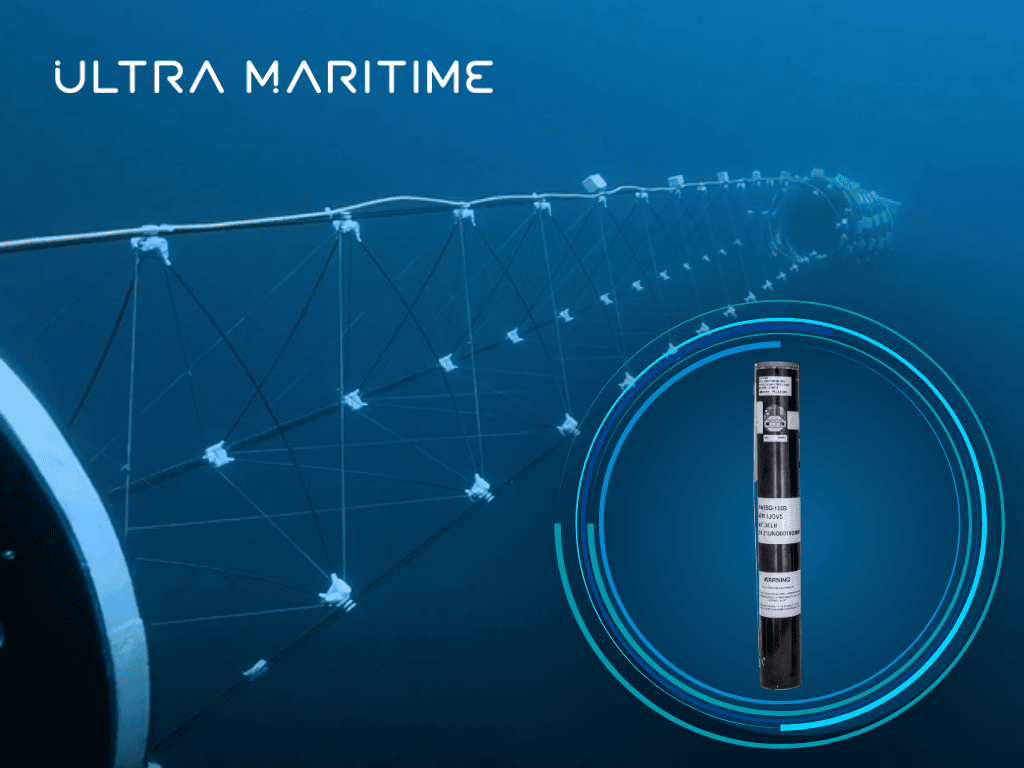
Naval defense technology provider Ultra Maritime has deployed an integrated sonar detection architecture designed to counter the growing threat of unmanned underwater vehicles, TechRadar Pro reported. As modern naval forces face an evolving threat landscape shifting away from individual crewed submarines toward swarms of low-cost autonomous drones, defense operators require advanced mechanisms to safeguard critical subsea assets. Unmanned underwater vehicles, or UUVs, present distinct operational challenges due to their small physical signatures and ability to target vital maritime infrastructure, including commercial piers, subsea telecommunications cables, and underwater energy pipelines.
Ultra Maritime's solution relies on pairing two distinct acoustic tracking devices to enhance subsea domain awareness: the Sea Spear, a deployable passive sonar array, and the AN/SSQ-125B, an active sonobuoy platform. Neither underlying technology represents a novel hardware paradigm, as passive listening arrays and active pinging systems have been utilized by the U.S. Navy and international allied forces since World War II, with the foundational principles of underwater acoustics dating back to World War I. However, Ultra Maritime's operational approach stems from how these two established sensing modes are algorithmically and tactically integrated.
The tactical advantage of the dual-system design lies in balancing stealth with positional accuracy. Passive sonar arrays function by silently monitoring ambient marine soundscapes, capturing target bearings without transmitting acoustic signals that would reveal the defender's geographic location. Because relying exclusively on active sonar exposes a vessel or monitoring station by broadcasting acoustic pings into the surrounding environment, Ultra Maritime's framework uses passive sensors as an initial detection filter. Once an anomalous signal is detected and verified as a potential target, the active sonobuoy is triggered to emit targeted pings, pinpointing the precise range and coordinates of the intruding UUV.
This integrated sensing strategy feeds into Ultra Maritime's broader operational framework, termed the "Ocean of Things." Under this concept, defense operators deploy a distributed mesh network composed of autonomous sensor nodes dropped from both crewed naval vessels and uncrewed aerial or surface platforms. By creating an interconnected web of low-cost sensors across target maritime sectors, the system establishes continuous subsea surveillance coverage that can scale dynamically depending on mission requirements and regional threat levels.
The defense technology firm validated the capabilities of its combined sonar platform during the U.S. Navy's 2026 Lanternfish military exercise. Throughout the exercise, Ultra Maritime successfully demonstrated that the paired passive array and active sonobuoy configuration could detect, track, and classify unmanned underwater vehicles featuring diverse physical dimensions and varied technological sophistication. In addition to its work with naval authorities, Ultra Maritime announced a technical integration between its Sea Spear system and defense hardware unicorn Anduril's Seabed Sentry platform, aiming to further automate subsea threat identification.
The operational developments coincide with major corporate consolidation within the defense technology landscape. Defense prime contractor Lockheed Martin recently finalized an agreement to purchase Ultra Maritime from private equity firm Advent International in a transaction valued at $3.45 billion. Following the completion of the acquisition, Ultra Maritime is slated to join Lockheed Martin's Rotary and Mission Systems division, expanding the aerospace giant's portfolio of subsea detection, electronic warfare, and maritime surveillance capabilities.
As international naval commands seek scalable solutions to mitigate the asymmetric threats posed by small autonomous craft, defense contractors are increasingly focusing on cost-efficient sensor networks rather than relying exclusively on high-cost capital ships. Ultra Maritime's approach underscores an industry transition toward combining long-term seabed infrastructure with disposable acoustic nodes and expendable active pingers. This multi-layered sensor matrix provides military customers with an adaptable defense posture designed to maintain subsea visibility without incurring prohibitive capital expenditures.
Sources
Written by
The Company Wire
Inside the companies building what’s next. Reporting on startups, technology, funding and the people shaping them.