AI Expert Oren Etzioni Breaks Down Generative AI Jargon, Compute Costs, and Model Access
An analysis of artificial intelligence terminology highlights key distinctions between training versus inference costs, open-weight distributions, and autonomous agents.
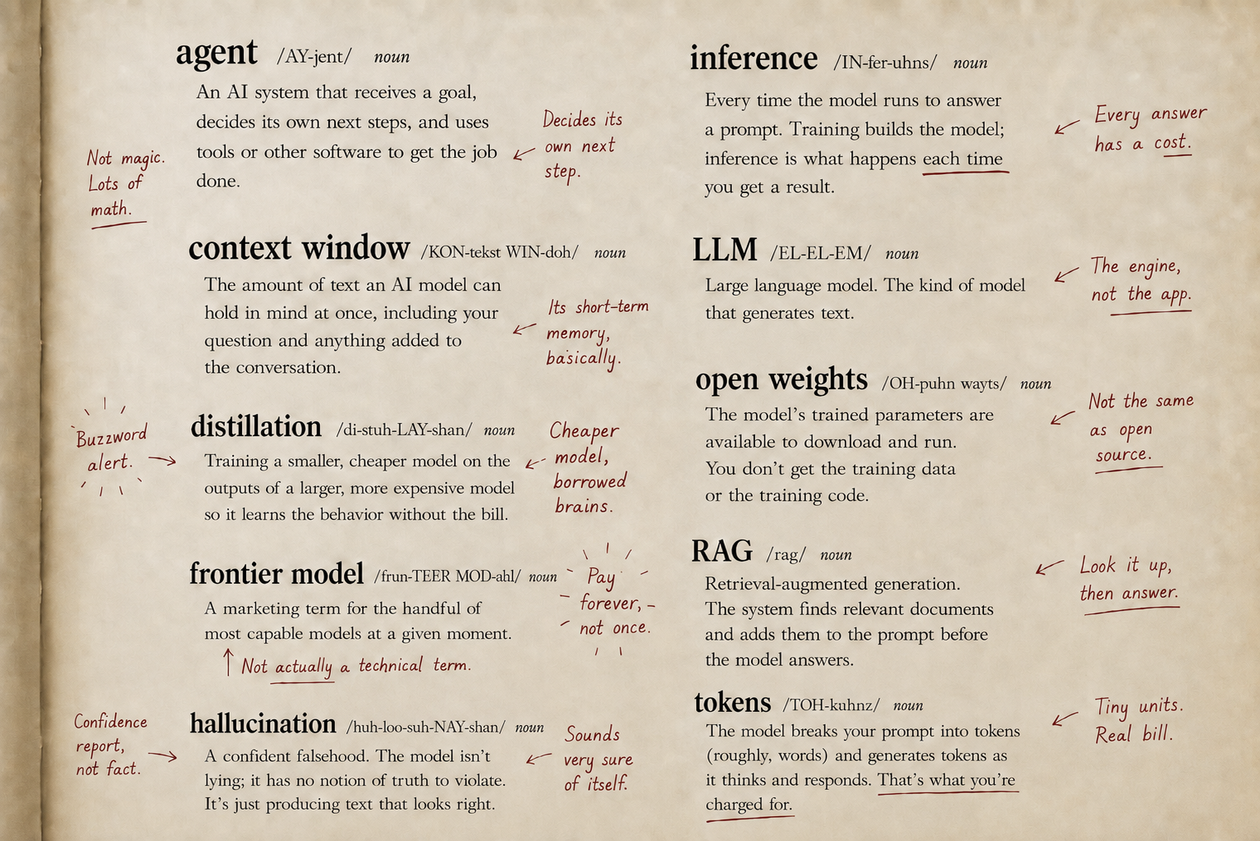
Computer scientist and artificial intelligence expert Oren Etzioni has published an analytical breakdown of core AI technology, business terms, and market terminology, seeking to clarify operational concepts shaping the sector, as first reported by GeekWire. The analysis outlines how technical definitions differ from public marketing language, detailing the mechanics that separate consumer applications like OpenAI's ChatGPT from underlying large language models (LLMs). Etzioni noted that terms like "frontier model" serve as informal industry rankings rather than precise technical categories, referencing primers by MIT Sloan's Rama Ramakrishnan that explain how modern generative models fundamentally operate through next-word prediction.
The analysis details the primary economic and operational metrics governing generative AI models, beginning with user inputs and prompts that are processed into tokens. Tokens serve as the primary unit of measurement that technology vendors use to calculate customer usage billing. Frontier models rely on parameters, or internal weights, which range from hundreds of billions to trillions of values in the largest systems. While pre-training models on vast internet datasets costs hundreds of millions of dollars and creates raw systems incapable of following instructions, post-training methods—such as reinforcement learning from human feedback (RLHF)—are required to transform statistical engines into functional products.
To avoid the extensive capital requirements of building models from scratch, some developers employ distillation, a process where smaller systems learn directly from the outputs of larger models to replicate capabilities at lower costs. The practice frequently conflicts with vendor terms of service, highlighting ongoing industry friction such as OpenAI accusing Chinese AI company DeepSeek of free-riding on American R&D in a memo submitted to Congress in February 2026, as reported by Rest of World. Etzioni emphasized that while upfront pre-training expenses generate public attention, ongoing inference costs represent the primary long-term operational expense. Citing research from Deloitte, the report noted that inference compute is projected to account for roughly two-thirds of all AI compute capacity in 2026, up from one-third in 2023.
The breakdown also evaluates model deployment models, distinguishing between proprietary API access, open-weight distributions, and true open-source software. While API-only models operate strictly on vendor infrastructure and charge per request, open-weight models allow developers to download parameter files and run them locally. However, Stanford HAI researcher James Landay and other commentators have characterized open-weight releases as "open distribution" or "open washing" because they omit underlying training code and data. Fully open-source AI projects remain uncommon across the commercial landscape, with the Allen Institute for AI's (AI2) OLMo model cited as a rare exception offering access to code, parameters, and datasets.
System execution features are defined by how models handle working context and operational autonomy. A model's context window limits the volume of text it can process simultaneously, leading developers to use Retrieval-Augmented Generation (RAG) to search external document databases and insert relevant data directly into active queries. For execution models, the analysis separates simple chatbots and static workflows from autonomous agents. Referencing technical framework guidance published by Anthropic in December 2024, the breakdown defines agents as systems capable of accepting high-level goals, independently determining sequential steps, and executing external software commands without direct step-by-step human control.
Addressing output reliability and content quality, Etzioni examined why generative models produce "hallucinations"—falsehoods generated because underlying evaluation benchmarks reward guessing over acknowledging ignorance, as documented in a September 2025 research paper from OpenAI. The analysis contrasts low-value, high-volume automated text, known as "AI slop"—which Merriam-Webster named its Word of the Year in December 2025—with high-quality AI-assisted writing, termed "AI cream."
Finally, the analysis outlines terminology surrounding system safety and governance, explaining that alignment research focuses on ensuring models adhere to human goals when operating autonomously. Protective boundaries are described differently across market segments: labeled as safety features in public press releases, guardrails in developer documentation, or censorship by critics on social networks like X. Etzioni pointed to OpenAI's Model Spec, updated in December 2025, as an example of published rules aimed at making refusal behaviors explicit rather than arbitrary.
Sources
Written by
The Company Wire
Inside the companies building what’s next. Reporting on startups, technology, funding and the people shaping them.