Enterprise Tech Reevaluates AI Economics as Frontier Model Costs Pressure Corporate Margins
A growing reliance on expensive third-party AI APIs is driving major technology companies toward hybrid hosting, open-weight models, and intelligent workload routing.
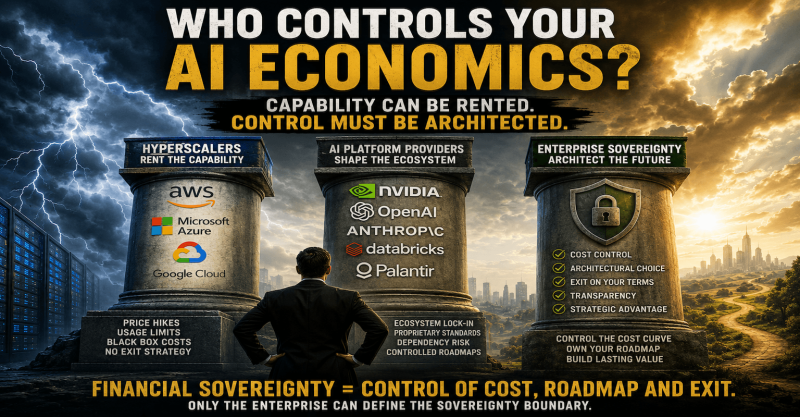
As artificial intelligence deployment scales across corporate IT environments, enterprises are increasingly shifting their focus from raw model consumption toward financial sovereignty and cost control, according to a recent market breakdown by SiliconANGLE. Tech vendors have traditionally encouraged organizations to measure progress through token counts and API calls, but a growing number of corporate executives are re-evaluating these usage metrics as third-party model bills begin to erode operating margins. The trend has given rise to the concept of 'sovereign alpha'—the practice of retaining maximum value from proprietary data and enterprise workflows by controlling model expenses and maintaining flexibility across software architectures.
The financial strain of relying exclusively on high-cost frontier models was recently underscored by graphic design platform Canva Inc. On Aug. 6, reportage from The Information revealed that Canva lowered its 2026 revenue expansion forecast from 30% to 20% due to unexpectedly high AI processing expenses. Despite generating over $900 million per quarter and maintaining top-line growth above 25%, the company was forced to adjust its financial guidance specifically because of input costs. In response, Canva overhauled its technology stack by deploying internal models, incorporating assets from its Leonardo.AI acquisition, and implementing task-level routing. These adjustments reportedly reduced individual AI task expenditures by approximately 90%, with its specialized video and image engines running 17 and 30 times cheaper than external frontier alternatives, respectively.
Canva is far from the only organization recalibrating its AI unit economics after encountering severe budget overruns. Ride-hailing giant Uber Technologies Inc. reportedly depleted its entire annual AI budget within a single quarter, prompting the company to modify default settings and redirect workloads toward lower-cost model tiers rather than scaling back AI integration. Meanwhile, Microsoft Corp. has increased investment in its own in-house model architectures while publicly indicating a desire to reduce and eventually eliminate its recurring payments to AI lab Anthropic PBC. For smaller technology firms, model costs have posed an even more immediate threat to profitability; AI agent startup Lindy, registered as Crivello Corp., reported that Anthropic APIs had grown into its largest single line-item expense, surpassing overall payroll before the company migrated its traffic to an alternative provider to lower costs and maintain core performance.
Palantir Technologies Inc. Chief Executive Alex Karp has forcefully criticized vendor-driven consumption models, coining the term 'tokenmaxxing' to describe scenarios where enterprises optimize for third-party billing rather than retained enterprise value. Karp argues that businesses must control their compute infrastructure, underlying models, and data pipelines to protect proprietary insights from being absorbed by foundation model providers. While Karp advocates deploying open-weight models on customer-controlled Nvidia Corp. graphics processing units using Palantir's software layer, SiliconANGLE notes that true sovereignty requires inspectable, permissively licensed open-source software, such as Apache 2.0 or MIT. Navigating software licensing remains critical for enterprises, as highlighted by Chinese automaker MG, which is currently embroiled in German court litigation over alleged failures to adhere to GPL open-source notice and source code requirements in its automotive microchips.
Distinguishing financial sovereignty from traditional Total Cost of Ownership (TCO) calculations is becoming a core strategic discipline for corporate technology leaders. While standard TCO models evaluate expected expenses under fixed operational parameters, financial sovereignty measures an enterprise's capacity to adjust those parameters and switch vendors without executing a complete system redesign. Upfront investments in self-hosted infrastructure and open-weight models can be substantial—frequently reaching tens or hundreds of millions of dollars for dedicated GPU clusters—yet they establish a predictable expenditure floor. This approach mimics early enterprise cloud strategies from 2010 to 2015, where organizations maintained dedicated data centers for baseline computing while bursting into public cloud environments during peak demand periods.
Industry experts recommend a hybrid operating strategy rather than a total repatriation of AI workloads. Under this model, organizations host persistent, sensitive, and predictable AI processes on controlled baselines powered by vetted open-weight models and governed infrastructure. External frontier APIs are reserved exclusively for high-value requests that justify premium pricing, such as complex reasoning, specialized evaluations, or niche domain tasks. By establishing explicit boundary conditions and managing where each query runs, enterprises prevent external API providers from becoming the default, single point of control for corporate intelligence workflows.
Central to executing a financially sovereign AI strategy is the adoption of dedicated intelligent routing gateways that dynamically direct prompts based on price, quality, regulatory requirements, and speed. The strategic importance of this infrastructure was highlighted this week when payment processing giant Stripe Inc. announced its intent to acquire model-routing platform OpenRouter for a reported $7.5 billion. By placing an intelligence gateway between enterprise applications and model providers, organizations can optimize workload placement at the edge, leveraging smaller, targeted models for routine tasks while containing exposure to fluctuating vendor pricing.
Sources
Written by
The Company Wire
Inside the companies building what’s next. Reporting on startups, technology, funding and the people shaping them.