Linux Developer Uses Mirror and Webcam to Let AI Debug Graphics Drivers Visually
An experimental setup pairs an Intel MacBook with an external mirror, allowing an AI coding agent to inspect display output while writing AMD Radeon code.
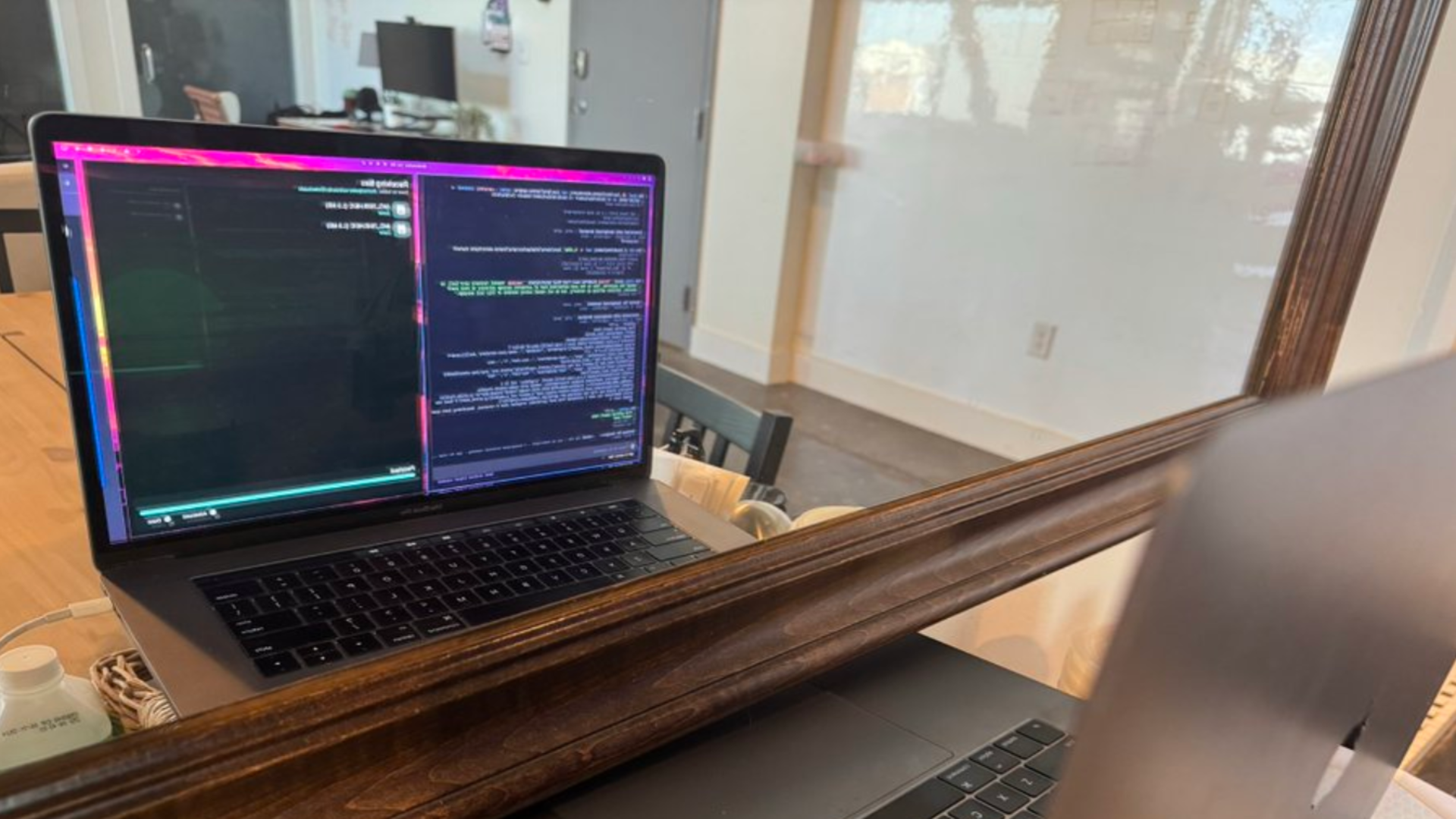
A developer has demonstrated an experimental artificial intelligence workflow that relies on physical optical feedback to write and debug device drivers. Independent Linux programmer Justin Schroeder designed a hardware arrangement pairing an older Intel-based MacBook with an external mirror aimed at the laptop's built-in webcam, allowing an AI coding agent to visually observe the real-time output of the display system it is actively modifying.
The unusual hardware loop routes the screen's physical rendering back into the computer's camera. By analyzing the reflected display image, the programming agent gains direct visual access to the immediate results of its code adjustments, bridging the gap between automated software generation and physical display monitoring.
As first reported by TechRadar Pro, the project was conducted during ongoing development work on Omarchy, an open-source Linux distribution being tailored to support AMD Radeon graphics hardware. Creating reliable graphics drivers typically requires ensuring that code changes translate into proper hardware operation across varied display environments and resolutions.
In standard graphics engineering, developers alter source code, compile the binaries, reload system services, and manually check the physical display to verify rendering quality. While automated test suites can evaluate text-based diagnostic logs and compiler success codes, traditional software tools often fail to capture subtle physical rendering errors that occur on screen during live execution.
The visual feedback mechanism addresses a fundamental challenge in display driver creation: code can compile without errors while still generating severe graphical glitches. A driver binary might pass all software-level compilation checks while producing distorted images, visible flickering, incorrect screen resolutions, or rendering artifacts when driving physical hardware.
By supplying the AI agent with a continuous camera feed of the reflected screen, Schroeder enabled the software to incorporate visual evaluation directly into its automated iterative coding process. Schroeder noted that granting the agent the ability to physically see the modified display provides crucial contextual data during active testing, allowing the system to detect visible failures and determine which specific code blocks require further refinement.
The experimental process automates sequential trial-and-error iterations without requiring a human developer to manually inspect every intermediate build output. This eliminates the necessity of constant human monitoring during early-stage driver tweaking, effectively giving the AI agent a direct line of visual perception regarding how software changes impact physical hardware performance.
However, the test configuration represents an exploratory proof-of-concept rather than a complete replacement for human software engineering. The demonstration does not prove that the automated agent can independently construct a production-ready AMD Radeon driver from scratch, nor does it establish whether this optical feedback method can reliably scale across complex software engineering environments.
Sources
Written by
The Company Wire
Inside the companies building what’s next. Reporting on startups, technology, funding and the people shaping them.