Markdown Emerges as the Lean Standard for LLM Context Ingestion
API providers and developers are turning away from nested JSON in favor of Markdown to curb token consumption and match model training distributions.
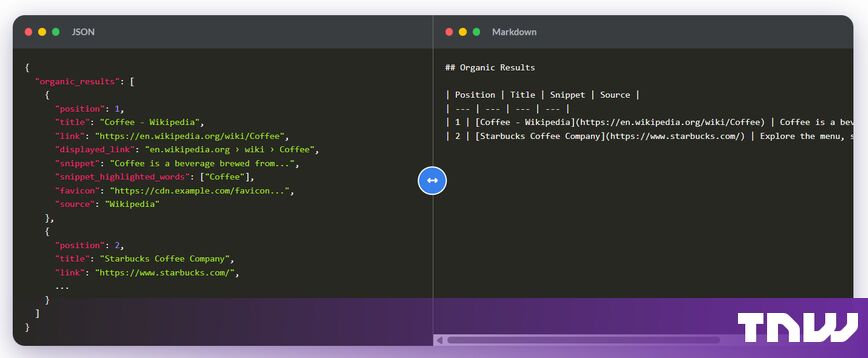
A shift is underway across the software infrastructure powering artificial intelligence applications, as data providers and developers increasingly adopt Markdown over JavaScript Object Notation (JSON) to feed external context into large language models. While JSON remains the long-standing standard for web API data interchange and programmatic manipulation, technical teams are finding that Markdown offers major efficiency gains when presenting information to LLMs and agentic workflows.
The transition reflects how modern generative models are trained and how chat applications render answers. Foundation models ingest vast quantities of documentation sites, README files, technical blogs, and knowledge repositories formatted in Markdown, allowing them to treat headers, bulleted lists, and tables as direct semantic signals rather than structural noise. Feeding Markdown into an LLM creates an intuitive input-output loop, as front-end chat interfaces can directly display the model's generated Markdown without additional transformation layers.
Token optimization serves as the primary commercial driver. As detailed in an analysis published by The Next Web (https://thenextweb.com/news/markdown-default-language-search-data-ai-models), JSON structures impose heavy token overhead through brackets, quotation marks, and repeated key names. Markdown eliminates this structural bloat while preserving core informational payloads, maximizing the usable capacity of model context windows and lowering per-request inference costs. Major model providers, including OpenAI, now explicitly recommend structuring prompt instructions and context using Markdown headers, lists, and tables to improve model instruction compliance.
API services are adapting their delivery formats to support this paradigm. Search-data provider SerpApi recently rolled out Markdown output support across its catalog of more than 100 APIs at no additional cost. The feature allows developers building LLM agents to request structured web search data using an API query parameter, route extension, or HTTP accept header instead of traditional JSON endpoints.
According to SerpApi's internal benchmarks, converting raw API responses into Markdown yields significant token reductions. In a vendor test query for the term "coffee" on Google Search, a standard JSON payload consumed 24,723 tokens, whereas the equivalent Markdown output required 6,435 tokens—a 74% reduction. Applying field filtering lowered that footprint further to 1,298 tokens. SerpApi reported average token savings of roughly 50% across its catalog, with select endpoints seeing decreases of up to 90%.
Search payloads are typically laden with tracking parameters, redirect paths, favicons, and deeply nested attributes that provide little utility for language reasoning. Markdown outputs strip this secondary noise while organizing titles, snippets, links, ratings, and prices into compact tables and lists, preceded by YAML frontmatter for essential metadata. As autonomous agents become primary consumers of web data, data providers across e-commerce, mapping, and content search are expected to standardize on Markdown endpoints to optimize context retrieval.
Sources
Written by
The Company Wire
Inside the companies building what’s next. Reporting on startups, technology, funding and the people shaping them.