Open-Source Tools Address AI Context Fragmentation with Portable Storage Architecture
A new open-source architecture uses Model Context Protocol and ahead-of-time schema compilation to build vendor-neutral memory systems for AI assistants.
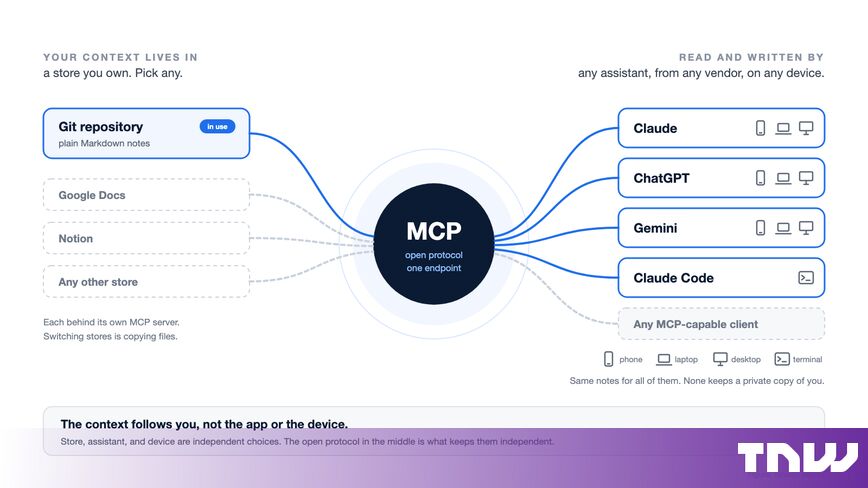
While artificial intelligence assistants have established sophisticated systems for retaining context in software development, personal memory features remain constrained by proprietary vendor silos. As first reported by The Next Web, software developers currently utilize an array of structured context tools for coding agents, whereas general conversational AI lacks a standardized, portable context architecture that can travel across different model platforms and interfaces.
In AI-assisted programming, context management spans several technical layers. Developers deploy project instruction files including CLAUDE.md, AGENTS.md, Cursor rules, and GitHub Copilot custom instructions to direct model behavior. Structural tools like repository maps, codebase indexers, and search integrations supply structural codebase representations, while persistence frameworks such as Cline's Memory Bank, Cursor session logs, and Claude Code memory directories preserve cross-session state. Specialized developer memory frameworks, including mem0, Letta, and Zep, further offer temporal knowledge graphs and retrieval pipelines to track codebase changes over time.
In contrast, conversational AI interactions involving personal health, financial portfolios, or administrative records rely on platform-specific memory implementations inside applications such as ChatGPT, Claude, and Gemini. Memory portability across these consumer tools remains minimal or restricted to one-way imports controlled by platform vendors. Furthermore, enterprise memory frameworks like mem0, Letta, and Zep store context within their own database layers, transferring lock-in from consumer AI providers to third-party infrastructure startups.
To address context fragmentation, an open-source system called vault-mcp implements a separation-of-concerns architecture that isolates personal context storage from model providers. The system stores user data as plain Markdown notes inside a Git repository—formatted as an Obsidian vault—and connects to AI models through a single remote Model Context Protocol (MCP) endpoint. By utilizing MCP as an open standard, identical context files can be accessed across web interfaces, desktop clients, mobile applications, and terminal tools like Claude Code without locking data to a specific vendor.
The vault-mcp system is designed to run on serverless edge infrastructure using the GitHub API transport layer. Security controls include append-only write permissions that prevent note deletion, Git commit tracking for auditing and rollbacks, and separated credentials that isolate user authentication from server access scopes. To defend against prompt injection attacks originating from stored notes, the server processes retrieved Markdown text strictly as data rather than system instructions.
Deploying the server on serverless edge platforms revealed performance bottlenecks related to input validation. The official MCP SDK relies on Zod, a TypeScript schema validation library with nearly 100 million weekly downloads. Zod achieves high execution speeds by generating specialized JavaScript code at runtime during initial validation calls. However, multi-tenant edge platforms such as Cloudflare Workers disable dynamic runtime code generation for security reasons, forcing Zod to run in a slower interpreted fallback mode.
To resolve the edge runtime bottleneck, the project led to the creation of Zod AOT, an open-source ahead-of-time compiler. Zod AOT compiles static Zod schemas into flat JavaScript functions during the build process, bypassing edge platform restrictions on runtime compilation and eliminating cold-start latency on serverless nodes. In benchmark tests, the precompiled validators executed validation checks on complex nested objects up to 60 times faster than Zod's standard runtime fast path.
The development of portable context layers coincides with broader industry adoption of MCP across third-party services and e-commerce platforms. As external services expose MCP endpoints to automate real-world actions, user-controlled context layers allow AI agents to reference personal preferences, prior purchases, and operational constraints without transferring permanent data ownership to vendor platforms or external storefronts.
Sources
Written by
The Company Wire
Inside the companies building what’s next. Reporting on startups, technology, funding and the people shaping them.


