Mercury Raises $200 Million at a $5.2 Billion Valuation
The business-banking technology company is growing alongside a new wave of AI startups while pursuing approval for a national bank.
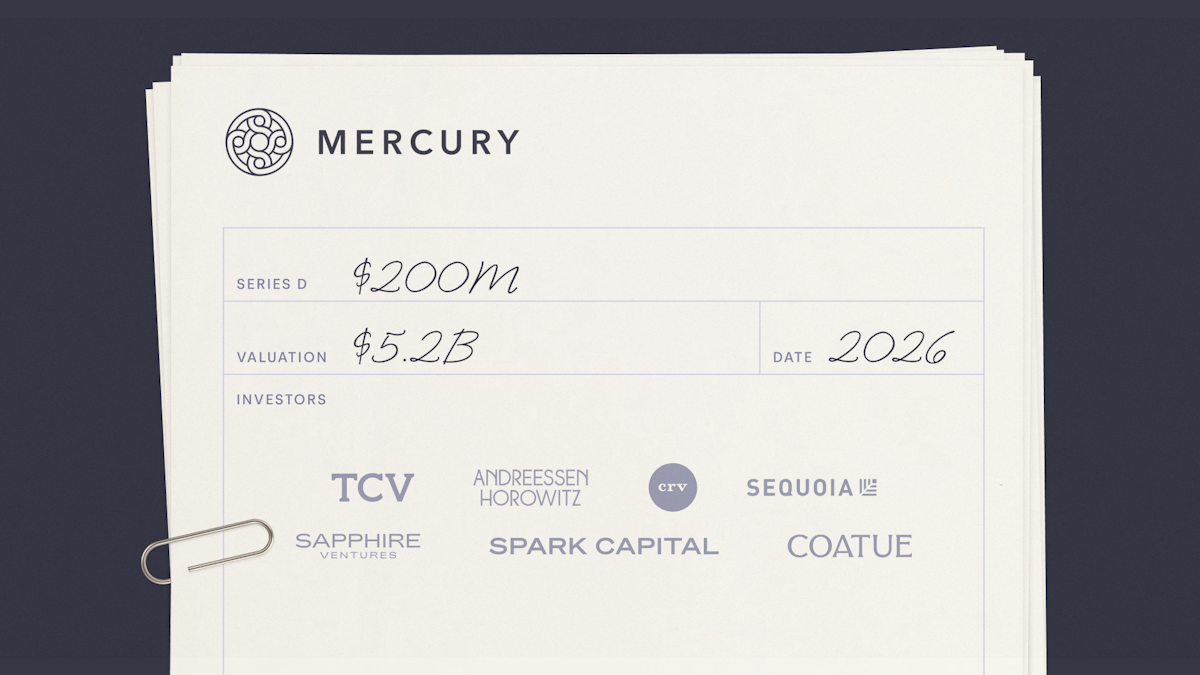
SAN FRANCISCO, Calif. - Mercury, the financial technology startup that has become a mainstay for the American venture capital ecosystem, has raised $200 million in Series D financing, the company announced. The investment values the San Francisco-based firm at $5.2 billion, signaling robust investor confidence in the fintech sector's ability to capture share from traditional banking institutions. Growth equity firm TCV led the round, which saw participation from a prominent roster of returning backers including Andreessen Horowitz, Coatue, CRV, Sapphire Ventures, Sequoia Capital, and Spark Capital. The fresh infusion of capital arrives as the company transitions from a specialized tool for tech founders into a primary financial platform for a broader segment of the corporate world.
The valuation and the pedigree of the participating investors reflect Mercury’s established position within the Silicon Valley lifecycle. Unlike many high-growth fintech peers that struggled during the recent period of rising interest rates, Mercury has maintained a trajectory of growth and profitability. Co-founder and Chief Executive Immad Akhund disclosed that the company now serves more than 300,000 businesses, a scale that highlights the firm's reach beyond its initial niche. According to reports from Reuters, the company has attained approximately $650 million in annualized revenue and has sustained profitability for the past four years, a rarity in a sector often defined by heavy cash burn.
Central to Mercury's recent momentum is the explosive growth of the artificial intelligence sector. As venture capital flows into generative AI and related infrastructure, a new generation of startups is forming at a rapid clip. Mercury estimates that roughly one-third of early-stage U.S. startups currently use its platform, making it a bellwether for the health of the broader innovation economy. The company serves as the initial financial gateway for many of these firms, providing the core infrastructure needed to manage venture debt, payroll, and operational expenses from the moment of incorporation.
External data reinforces the narrative of a quickening pace in business formation. Mercury noted that its application volume increased two and a half times year over year during the first quarter of 2026. This surge significantly outpaced the general U.S. market, where business applications rose by a respectable 18 percent over the same period. The discrepancy suggests that while the general economy is seeing a lift in entrepreneurial activity, Mercury is disproportionately benefiting from the specific density of technology-focused ventures currently entering the market.
For years, Mercury has operated under a partner-bank model that is standard for the fintech industry. In this arrangement, the company provides the front-end software interface, user experience, and specialized features for startups, while regulated partner banks hold the actual deposits and deliver the underlying banking services. This allows fintech firms to scale quickly without the immediate burden of full banking licenses, though it creates a layer of dependency on the operational stability and regulatory standing of third-party financial institutions.
Mercury is now moving to internalize that core infrastructure. The company has received conditional approval from the Office of the Comptroller of the Currency (OCC) to form Mercury Bank. If finalized, this charter would allow Mercury to act as a national bank, independent of the partner-bank mandates that currently underpin its business model. This strategic pivot is intended to give the firm more granular control over its product roadmap, fee structures, and the economics of its lending and deposit-taking activities.
Securing a national bank charter is a high-stakes endeavor that involves rigorous oversight. While the conditional approval marks a significant milestone, final approval remains subject to meeting a series of stringent regulatory requirements. The transition from a software-focused fintech to a chartered bank involves a fundamental shift in corporate identity. It requires the establishment of sophisticated governance structures and the adoption of a risk-management posture that mirrors the largest financial institutions in the country.
The $200 million in Series D funding is expected to support the company as it navigates this complex regulatory process. Beyond the legal and compliance costs of becoming a bank, the capital will be directed toward ongoing product development and the expansion of its service suite. Mercury has recently moved to broaden its offerings to include sophisticated treasury management and larger-scale credit products, positioning itself to retain customers as they grow from seed-stage startups into mature, pre-IPO enterprises.
Industry analysts have noted that the move toward a full bank charter is part of a maturing trend among top-tier fintech companies. By becoming a bank, Mercury could potentially deepen its relationships with customers, offering more integrated financial products that are difficult to manage through third-party intermediaries. However, the path is fraught with increased obligations regarding compliance, capital reserves, and risk management. Regulators such as the OCC demand high levels of transparency and stability, which can sometimes clash with the agile, iterative culture of a software company.
The fintech landscape has faced significant scrutiny over the past eighteen months, particularly concerning the safety and soundness of partner-banking relationships. By pursuing its own charter, Mercury is attempting to insulate itself from the systematic risks associated with the broader banking-as-a-service market. If successful, it would join a small group of technology-first firms that have effectively bridged the gap between the speed of Silicon Valley and the stability of the federal banking system.
The next phase of Mercury's evolution will test its ability to maintain a fast, user-friendly software experience while simultaneously meeting the heavy operating standards of a national financial institution. The company's value proposition has long been rooted in its superior design and specialized tools for founders; the challenge will be ensuring that the introduction of rigorous banking protocols does not degrade the efficiency that drew customers to the platform originally.
As Mercury moves forward with the Series D capital and its banking aspirations, the market will be watching its ability to scale its revenue and customer base in a shifting interest rate environment. The company’s focus on the AI sector provides a tailwind, but it also ties Mercury's fortunes to the continued success of the tech industry's latest hype cycle. For now, the backing of TCV and other elite venture firms suggests that the market believes Mercury is the leading contender to define the future of corporate banking for the innovation economy.
Sources
Written by
The Company Wire
Inside the companies building what’s next. Reporting on startups, technology, funding and the people shaping them.

.jpg)