Nvidia Reportedly Invests $5 Billion in Safe Superintelligence
The chipmaker's strategic partnership with Ilya Sutskever's research lab couples new capital with access to Vera Rubin computing systems.
PALO ALTO, Calif. - Nvidia has formed a long-term strategic partnership with Safe Superintelligence, the closely watched artificial intelligence research company co-founded by Ilya Sutskever. Reuters reported that the agreement includes a $5 billion equity investment, citing a person briefed on the transaction. The companies announced the partnership without disclosing its financial terms, marking one of the most significant capital commitments to an early-stage AI research outfit to date. The deal frames the growing intersection between hardware dominance and theoretical research, positioning the world's most valuable chipmaker as a foundational pillar for a company specifically designed to solve the challenges of sovereign, safe AI systems.
The arrangement is designed to expand SSI's computing capacity as the company pursues its stated goal of developing safe superintelligence. Nvidia said the startup will gain access to systems based on its Vera Rubin platform, the successor to its Blackwell architecture that was recently unveiled to handle the next generation of massive-scale training requirements. The partners expect the deployment to increase SSI's available compute by roughly an order of magnitude over the next year, a scale-up that indicates the sheer volume of processing power required to advance the current state of frontier models.
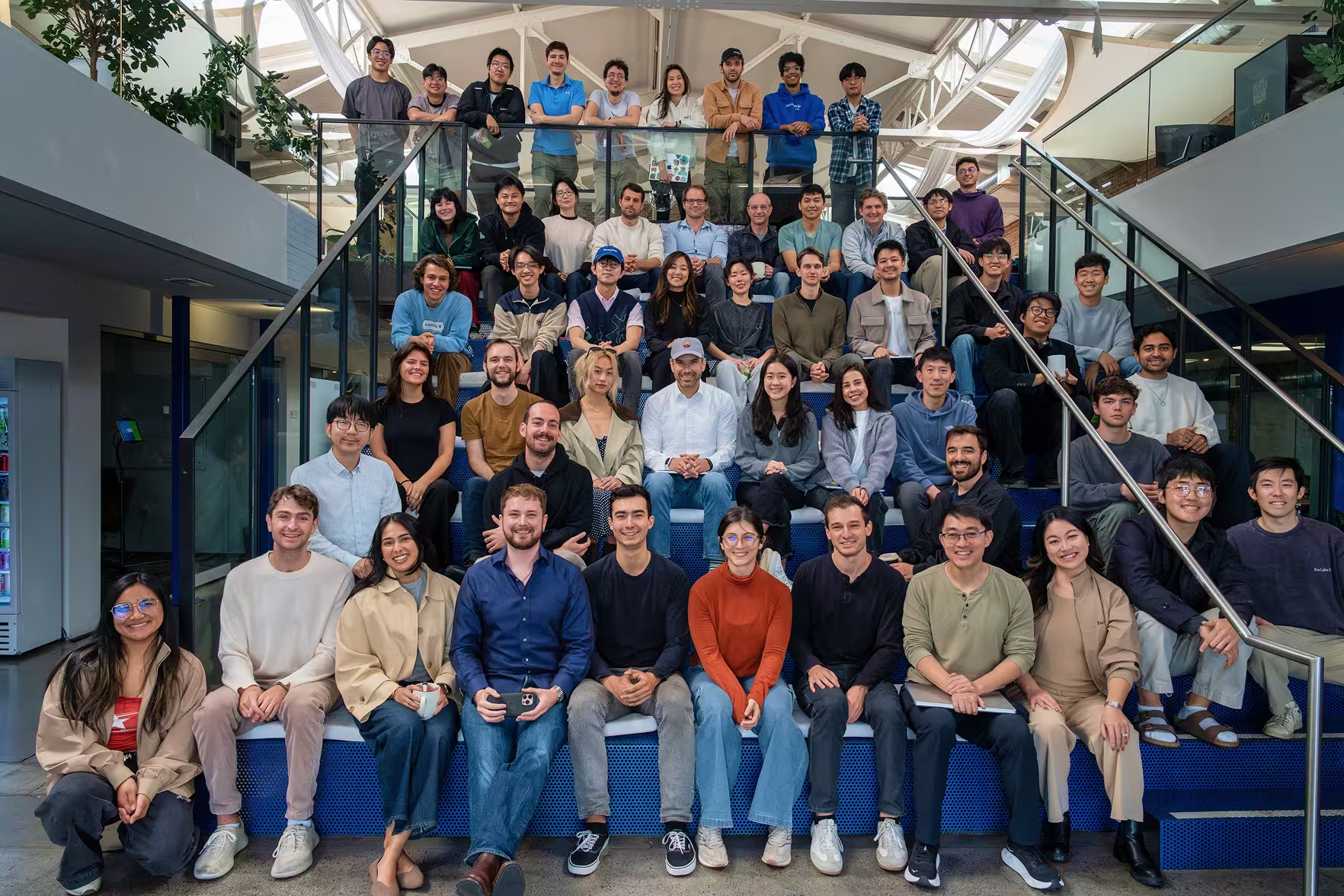
SSI has maintained an unusually narrow public mission since its 2024 formation, emphasizing a single research objective instead of releasing consumer or enterprise products. While competitors have raced to debut chatbots, image generators, and coding assistants to capture immediate market share, SSI has remained focused exclusively on the long-term goal of safety at the super-intelligent level. The company operates from Palo Alto and Tel Aviv, drawing on deep pools of engineering talent in two of the world's most prolific technology hubs. Its limited public detail has made access to talent, capital and advanced chips central signals of how quickly the laboratory intends to scale its operations.
For Nvidia, the partnership deepens its relationship with an important frontier-model developer while placing its newest hardware inside another demanding research environment. By integrating the Vera Rubin platform into SSI's research pipeline, Nvidia ensures that its architecture remains the industry standard for the most complex theoretical work being performed in the valley. It also illustrates how leading chip suppliers are using investment and infrastructure agreements to secure long-term ties with the laboratories most likely to consume large amounts of accelerated computing, effectively creating a symbiotic ecosystem between the silicon provider and the software innovator.
The reported investment is significant, but the amount remains based on independent reporting rather than the companies' formal announcement. Editors and analysts should preserve that distinction, as the lack of an official valuation figure keeps the exact mechanical nature of the equity deal under wraps. However, a $5 billion figure would place SSI among the most well-capitalized startups in history relative to its age, signaling immense investor confidence in Sutskever's vision and the technical roadmap he and his co-founders have laid out since departing their previous roles.
The larger test will be whether SSI can translate substantially greater computing resources into research progress while maintaining the safety-first discipline on which the company was founded. The industry has frequently seen a tension between the massive computational requirements of scaling laws and the rigorous, often slow-moving guardrails required to ensure alignment. By securing an order of magnitude increase in compute through Nvidia, SSI is removing a primary physical bottleneck, shifting the burden of proof to its theoretical approach and its ability to manage the risks inherent in super-intelligent systems.
Nvidia's decision to deploy the Vera Rubin platform within SSI's labs is a tactical move that underscores the importance of high-bandwidth memory and advanced interconnects in modern AI training. As models grow in complexity, the hardware required to train them must evolve from simple clusters into highly integrated supercomputing environments. This partnership provides Nvidia with a direct feedback loop from some of the most sophisticated users of its hardware, potentially influencing the design and optimization of future chip iterations intended for the highest tiers of research.
The strategic nature of the deal also reflects a broader trend of vertical integration within the AI sector. As the cost of training frontier models climbs into the billions of dollars, the distinction between a venture investment and a procurement agreement has blurred. For SSI, the deal is as much about securing a guaranteed supply chain of the world’s most sought-after GPUs as it is about the cash infusion. In an era where silicon scarcity can stall a research program for months, having a direct line to Nvidia's latest architecture is a monumental competitive advantage for a startup.
The Palo Alto and Tel Aviv teams are expected to use the new capital to aggressively recruit from a small pool of top-tier AI researchers. In the current labor market, the promise of massive compute resources is often the deciding factor for high-level engineers choosing between established tech giants and nascent startups. By signaling a $5 billion backing and access to the Vera Rubin platform, SSI is making a powerful play for the human capital necessary to achieve its singular research goal, positioning itself as the primary alternative to more commercialized labs.
Industry analysts have noted that Nvidia’s investment strategy has increasingly focused on companies that push the boundaries of what is possible with GPU acceleration. By backing SSI, Nvidia is betting on a philosophical shift in the industry toward safety-centric development. If SSI succeeds in its mission, it could set the standards for how future AI systems are built and governed, with Nvidia’s hardware serving as the literal foundation for those global safety benchmarks.
As the deployment of the Vera Rubin systems begins over the next twelve months, the industry will be watching for any shift in SSI's traditionally quiet stance. While the company has avoided the product-led cycles of its peers, the influx of $5 billion suggests a move toward a more industrial scale of experimentation. The sheer power of an order-of-magnitude increase in compute suggests that SSI is moving beyond purely theoretical frameworks and into the realm of massive-scale verification and testing of its safety models.
The partnership also highlights the geopolitical and economic weight of the AI infrastructure race. With massive investments flowing into Palo Alto and Tel Aviv, the nexus of AI development remains concentrated in regions with established technical ecosystems. Nvidia’s role as both a financier and a supplier in this deal reinforces its status as the central clearinghouse for the AI economy, where capital and computing power are exchanged to fuel the next leap in machine intelligence.
Ultimately, the success of the Nvidia-SSI partnership will be measured by its ability to resolve the existential questions surrounding AI safety before the technology reaches a point of no return. The financial commitment reported by Reuters suggests that neither company views this as a minor experiment. Instead, it is a high-stakes bet that the marriage of unprecedented computing power and a singular focus on safety will produce the breakthrough needed to manage the transition to a world of super-intelligent machines.
Sources
Written by
The Company Wire
Inside the companies building what’s next. Reporting on startups, technology, funding and the people shaping them.