Outmarket AI Raises $17 Million to Automate Insurance Brokerage Work
The vertical software company is connecting agency data with AI workflows for policy checks, proposals and other document-heavy tasks.
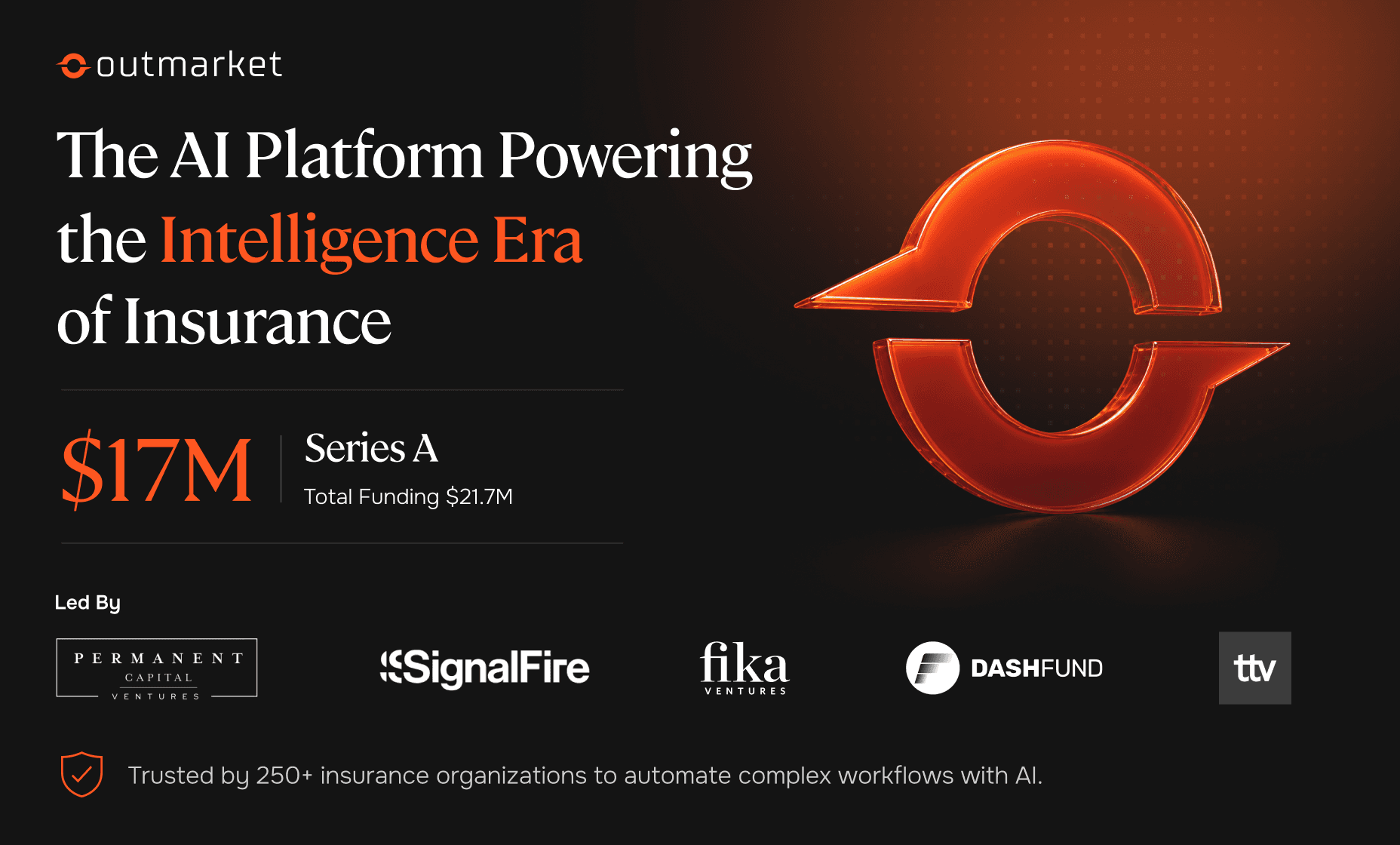
SAN FRANCISCO, Calif. - Outmarket AI has raised $17 million in Series A financing led by Permanent Capital Ventures, marking a significant injection of capital into the specialized vertical software sector for insurance distribution. The funding round saw participation from a broad syndicate of investors including SignalFire, Fika Ventures, TTV Capital, and Dash Fund, alongside a group of strategic insurance-industry investors. This latest infusion brings the San Francisco-based company’s total funding to $21.7 million, positioning the firm to accelerate its attempts to modernize the back-office operations of traditional insurance brokerages through applied artificial intelligence.
The core of Outmarket’s value proposition lies in its ability to connect directly with insurance agency management systems, which have historically functioned as fragmented repositories of unstructured data. By integrating with these systems, Outmarket transforms brokerage data into a functional operating layer designed for automated workflows. This shift seeks to move the industry away from manual data entry and toward a model where intelligence is embedded directly into the transaction lifecycle of a policy, from initial lead generation to the finalization of coverage terms.
Outmarket’s suite of tools is designed to handle some of the most labor-intensive tasks within a brokerage, including policy checking, the preparation of client proposals, and complex loss-run analysis. These functions span a wide variety of insurance categories, addressing needs across commercial lines, employee benefits, personal insurance, and specialty markets. The company reports that its platform is currently utilized by more than 250 brokerages, suggesting a degree of product-market fit in a sector that has been historically slow to adopt new technological frameworks.
The investment arrives as the broader fintech and enterprise software landscapes show an increasing preference for vertical AI solutions over general-purpose language models. Analysts have noted that while horizontal AI tools can draft emails or summarize general text, they often lack the domain-specific logic required for high-stakes financial services. In the context of insurance distribution, the industry remains heavily dependent on physical documents, manual side-by-side comparisons, and the institutional knowledge held by long-tenured staff members who understand the nuances of various carrier forms.
Advocates for specialized AI argue that a purpose-built system is inherently more useful for a broker than a general digital assistant. To provide real value, an automation platform must demonstrate a deep understanding of complex policy structures, specific brokerage operational processes, and the idiosyncratic ways data is stored within legacy industry software. As Outmarket processes an increasing volume of transactions, it has the opportunity to improve its product by identifying and codifying recurring workflow patterns that are common across the brokerage landscape.
Despite the potential for gains in efficiency, the implementation of AI in insurance brokerage carries substantial risks, with technical accuracy serving as the primary concern. In the insurance world, a single missed exclusion in a policy or an incorrect figure in a coverage comparison can expose both the broker and the end client to significant financial loss and potential litigation. This reality places a high premium on the reliability of the underlying algorithms and the precision of the data extraction processes employed by the platform.
To mitigate these risks and gain the trust of conservative risk managers, customers will likely require robust review controls, detailed audit trails, and a clear framework for establishing responsibility when an automated output proves to be incorrect. The 'human-in-the-loop' model remains a critical component of professional services automation, where the technology serves to augment rather than replace the oversight provided by licensed professionals who carry the ultimate fiduciary and professional liability.
Outmarket also faces a competitive landscape that includes established agency management software vendors who may seek to defend their market share by adding similar automated functions to their existing products. Furthermore, the company’s growth is contingent on continued access to data; insurance carriers and large brokerages may occasionally choose to limit third-party access to sensitive policy information due to privacy concerns or competitive positioning, potentially creating bottlenecks for platform integration.
The proceeds from the Series A round are slated to fund the development of additional workflows, deeper product engineering, and a broader expansion across the insurance industry. As the company scales, it will need to navigate the transition from a specialized tool for early adopters to a standard piece of the insurance technology stack. This involves not only technical development but also the navigational challenges of integrating with a diverse set of participants in the multi-tiered insurance distribution chain.
Market observers suggest that the success of the platform will ultimately be measured by tangible performance indicators, specifically measured reductions in processing time and the elimination of human error across its growing customer base. In an environment where brokerages are under pressure to improve margins while dealing with a talent crunch, a platform that can quantifiably prove it reduces the hours required to service a policy will hold a significant competitive advantage over traditional methods.
The broader venture capital interest in this space reflects a belief that insurance is among the largest remaining sectors ripe for a profound workflow overhaul. Because insurance is fundamentally a business of data and contracts, it is theoretically well-suited for the current generation of machine learning and natural language processing tools. However, the complexity of state-by-state regulations and the sheer variety of niche coverage types make it a difficult environment for outsiders to penetrate without a specialized approach.
As Outmarket moves forward with its new capital, its primary challenge will be to prove that its automation strengthens professional judgment rather than merely creating another layer of administrative overhead that brokers feel compelled to check manually. If the platform can successfully act as a reliable co-pilot for the brokerage team, it may set a new standard for how insurance products are managed and sold in an increasingly digital economy.
Sources
Written by
The Company Wire
Inside the companies building what’s next. Reporting on startups, technology, funding and the people shaping them.
.jpg)