Positron Raises $875M at $5B Valuation to Build AI Hardware with Consumer Memory
The Reno-based chipmaker aims to circumvent high-bandwidth memory shortages by deploying smartphone memory modules for enterprise inference workloads.
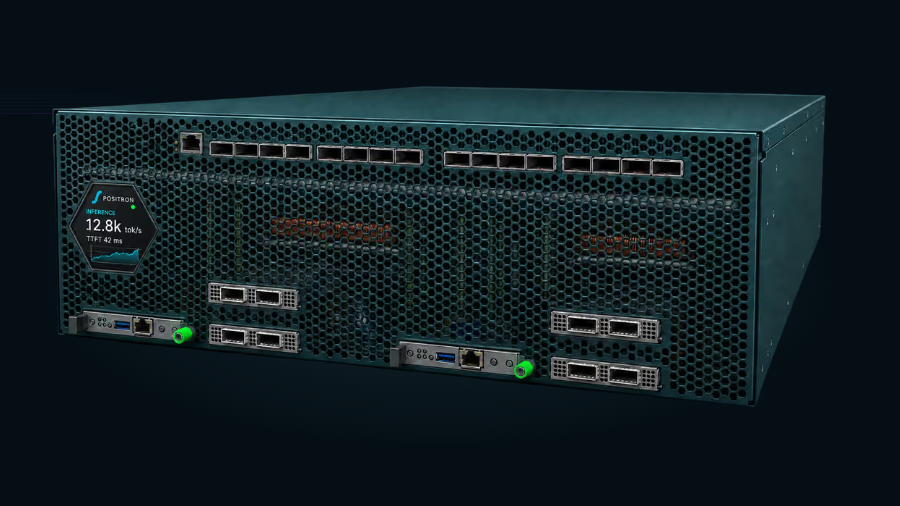
Positron AI Inc., a Reno, Nevada-based chipmaker developing specialized artificial intelligence inference hardware, announced today that it has secured $875 million in a new funding round. As first reported by SiliconANGLE, the investment elevates the startup's valuation to $5 billion—a fivefold rise since February—and will help the company commercialize systems that rely on mobile device memory rather than standard high-bandwidth hardware.
The round was co-led by venture firms NEA, Atreides Management, Valor Equity Partners, Andra Capital, and SemiAnalysis Capital, alongside Netscape co-founder Jim Clark. More than 12 other institutional investors participated in the financing. Positron designs hardware targeted at artificial intelligence inference, focusing on avoiding current supply bottlenecks associated with High Bandwidth Memory (HBM) and specialized interconnect technologies used in standard data center GPUs.
Because running large language models requires transferring massive amounts of data between memory circuits and computing cores, memory bandwidth serves as a critical bottleneck for inference performance. While standard enterprise accelerators rely on scarce and expensive HBM, Positron utilizes LPDDR5X memory, a cheaper and more plentiful format commonly found in smartphones. Although LPDDR5X features lower baseline bandwidth than HBM, Positron claims its architectural design captures over 90% of the memory's total throughput, contrasting with standard AI chips that utilize less than 30% of their HBM bandwidth.
The startup's primary hardware system, designated Titan, incorporates up to 18.4 terabytes of LPDDR5X RAM providing 23.68 terabits per second of memory bandwidth. According to the company, this single-appliance capacity allows a Titan system to handle a 32-trillion-parameter large language model with context windows extending to 10 billion tokens. Each Titan platform houses up to eight custom silicon units named Asimov, with customer cluster configurations scaling up to 16,384 total accelerators.
The custom Asimov chip utilizes a systolic array architecture composed of uniform computing modules paired with co-located memory, which stores model weights locally during output generation. The design also integrates specialized activation function modules designed to route neural network pathways, alongside general-purpose central processing unit cores that act as programmable fallback units for tasks outside the hardware's primary optimization paths.
While neither the Titan appliance nor the Asimov processor are currently in commercial production, simulation figures provided by the company suggest a server rack equipped with its silicon can deliver up to 26 times more processed tokens per dollar than Nvidia Corp.'s Blackwell GB300 NVL72 platform. Positron plans to tape out the Asimov silicon on Taiwan Semiconductor Manufacturing Co.'s 3-nanometer process node at the end of this year, targeting full-scale manufacturing in the second half of 2027.
In conjunction with chip manufacturing, the startup intends to expand assembly of its Titan systems while securing supply guarantees for LPDDR5X memory. "Our focus now is to tape out Asimov, bring Titan to production, and scale manufacturing to meet the demand in front of us," said Positron Chief Executive Officer Mitesh Agrawal in a statement. "This financing gives us the resources to do exactly that."
Sources
Written by
The Company Wire
Inside the companies building what’s next. Reporting on startups, technology, funding and the people shaping them.