Render Adds $100 Million for a Cloud Platform Built Around AI Applications
The Series C extension values the developer platform at $1.5 billion as more teams need persistent infrastructure for applications and agents.
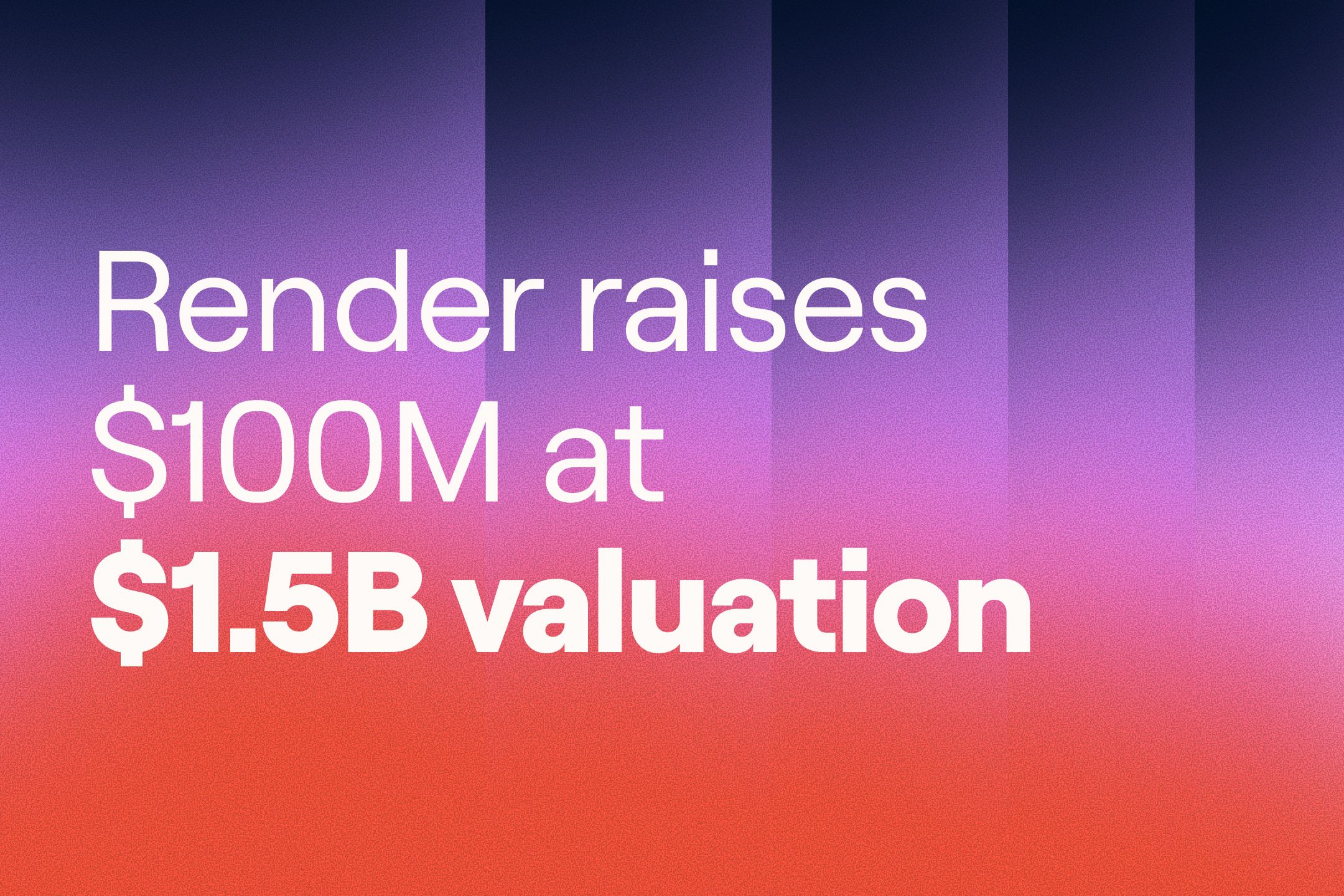
SAN FRANCISCO, Calif. - Render, a developer-centric cloud platform, has announced the closing of a $100 million extension to its Series C funding round. The new financing elevates the San Francisco-based company to a $1.5 billion valuation, according to reports and company statements. The investment was led by Georgian, with participation from previous backers including Addition, Bessemer Venture Partners, General Catalyst, and 01A. The capital infusion brings Render's total funding to date to $258 million, marking a significant milestone in its effort to provide an alternative to the dominant incumbent infrastructure providers.
As a primary competitor in the cloud hosting and deployment space, Render provides a managed environment where developers can deploy web services, databases, background workers, and other critical application components. The platform is designed to abstract away the underlying complexity of server management, allowing engineering teams to focus on code rather than the intricacies of provisioning virtual machines or managing container orchestration. This value proposition has gained traction as organizations move away from more fragmented infrastructure setups in favor of integrated environments that offer faster time-to-market.
The latest funding arrives as the tech industry undergoes a fundamental shift driven by the rise of artificial intelligence. Render is increasingly positioning its platform to handle workloads generated by AI-centric products and autonomous agents. Unlike traditional web applications that might rely primarily on short, stateless requests, modern AI applications often require sophisticated infrastructure features. These include long-running processes for model training or inference, private networking for data security, and WebSockets for real-time streaming of information. Render's emphasis on providing reliable connections to data stores is a direct response to these evolving technical requirements.
Market data highlights a notable surge in adoption for the platform, with Render reporting that more than 4.5 million developers have utilized its services. Furthermore, the company states that it is adding over 250,000 new developers to its ecosystem every month. While these figures are company-reported, they underscore a broader industry trend where small-to-medium teams seek cloud flexibility without the overhead of manually assembling every layer of their infrastructure stack. This 'low-friction' approach is becoming a key differentiator in a market historically dominated by the steep learning curves of Amazon Web Services, Microsoft Azure, and Google Cloud.
The rise of AI-assisted coding tools, such as GitHub Copilot and other generative models, plays into Render's core strategy. While these tools allow developers to write and iterate on code with unprecedented speed, the resulting software still requires a secure, scalable, and observable runtime. Analysts have noted that the bottleneck in software development is shifting from the act of writing code to the act of deploying and maintaining it. Render views this shift as an opportunity, positioning its platform as the logical destination for the vast quantities of code being generated by human-AI collaboration.
In the broader competitive landscape, Render is navigating a crowded field that includes both legacy cloud providers and a new generation of simplified deployment platforms like Vercel and Netlify. The company must strike a delicate balance: it must offer enough convenience to appeal to individual developers and startups while simultaneously providing the robust security, governance, and observability controls expected by enterprise-grade customers. The tension between ease-of-use and technical depth remains one of the primary hurdles for developer platforms seeking to scale into the mid-market and beyond.
According to the company, the proceeds from the $100 million extension will be allocated toward several strategic initiatives, including the development of new products, the expansion of global infrastructure capacity, and a push into broader enterprise sales. By bolstering its infrastructure, Render aims to support the increasingly heavy compute and storage demands of its user base. The investment in enterprise sales signaling a move to capture larger contracts as more established organizations look to modernize their legacy deployment pipelines.
Industry observers suggest that Render's growth is reflective of a maturing cloud market where 'developer experience' has become a top-tier priority for Chief Technology Officers. The thesis driving this investment is that easier software creation will actually increase the long-term demand for dependable hosting rather than eliminating the need for operations work. By reducing the toil associated with deployment, Render allows teams to deploy more frequently, which in turn leads to a greater reliance on the underlying platform for uptime and scalability.
One of the critical tests for Render in the coming years will be its 'graduation' rate—specifically, whether developers who begin their journey on the platform with quick prototypes choose to remain as their traffic grows and their security requirements become more stringent. Historically, many simplified platforms have struggled to retain high-growth companies that eventually outgrow managed abstractions and seek the granular control of raw infrastructure. Render's technical roadmap, which includes more advanced networking and persistent storage features, appears designed to mitigate this risk of attrition.
The entry of Georgian as the lead investor for this extension suggests a focus on the data-intensive nature of modern applications. As AI agents become more prevalent, the need for persistent infrastructure that can handle stateful workloads becomes paramount. Unlike static sites or simple serverless functions, AI agents often require long-lived connections and consistent access to context-rich databases. Render's ability to support these 'persistent' workloads could prove to be its most significant advantage in the AI era.
Furthermore, the participation of heavyweights like Bessemer and General Catalyst indicates a continued belief in the structural growth of the developer tools sector. Despite a cooling in certain areas of the venture capital market, infrastructure remains a high-conviction category due to its recurring revenue models and the essential nature of the service. For Render, maintaining its growth trajectory at a $1.5 billion valuation will require not just adding users, but successfully moving up-market to serve more complex, multi-service architectures.
Looking ahead, the enterprise segment will likely be the primary battleground. Larger organizations often bring complex compliance needs, such as SOC2 readiness, VPC peering, and sophisticated role-based access controls. Render has been steadily checking these boxes to compete for larger workloads. The success of this Series C extension will ultimately be measured by Render's ability to convince these larger engineering organizations that they can achieve enterprise-scale reliability without the traditional overhead of a dedicated DevOps army.
In summary, Render's new funding highlights the growing importance of the 'Goldilocks' cloud—platforms that are more powerful than simple static hosts but more intuitive than the massive general-purpose clouds. As the volume of software continues to expand through AI-driven automation, the infrastructure that hosts that software is becoming less of a commodity and more of a strategic layer. Render is betting $100 million that it can remain the preferred home for this new generation of applications, provided it can scale its features as fast as its users scale their traffic.
Sources
Written by
The Company Wire
Inside the companies building what’s next. Reporting on startups, technology, funding and the people shaping them.