Temporal Raises $300 Million to Make AI Agents More Reliable
The durable-computing company reached a $5 billion valuation as enterprises look for infrastructure that can keep long-running AI work on track.
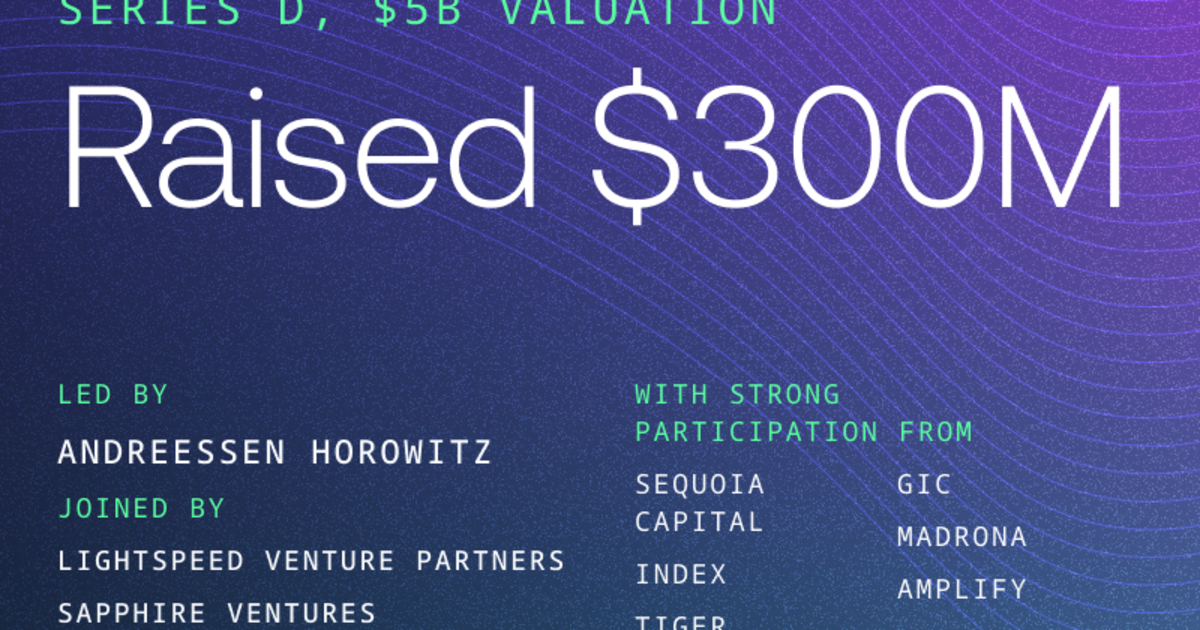
SAN FRANCISCO, Calif. - Temporal has raised $300 million in Series D financing at a $5 billion valuation, giving the San Francisco company fresh capital to expand the infrastructure behind long-running software and AI agents. The significant capital infusion was led by Andreessen Horowitz, with participation from Lightspeed Venture Partners and Sapphire Ventures. The round also saw participation from a robust bench of existing backers, including Sequoia Capital, Index Ventures, Tiger Global, GIC, Madrona, and Amplify Partners, signaling continued confidence in the company's core technology and its role in the evolving enterprise software stack.
The company addresses a practical and persistent weakness in automated systems that has plagued developers for decades: the fragility of distributed environments. In a traditional cloud architecture, a simple process can fail halfway through because a server restarts, a network call times out, or an outside service becomes temporarily unavailable. These transient errors often result in broken user experiences or corrupted data unless developers spend significant time writing complex logic to handle retries and state management. Temporal’s approach aims to abstract these difficulties away, allowing engineers to focus on business logic rather than infrastructure stability.
At the heart of the company's offering is what it calls Durable Execution technology. This system records the state of a workflow in a persistent manner, ensuring that if a process is interrupted by a hardware failure or a connectivity issue, it can resume from the exact point of failure instead of starting over or leaving a task incomplete. By maintaining a reliable history of execution, the platform provides a safety net for developers building mission-critical applications where a skipped step could result in financial loss or operational disruption.
This capability has become increasingly important as the technology sector moves from simple, short-lived chatbot exchanges to sophisticated AI agents that coordinate many tools over minutes, hours, or even days. While early generative AI deployments focused on providing immediate answers to prompts, the current wave of enterprise development is focused on 'agentic' workflows—software that can autonomously navigate multiple platforms, handle asynchronous responses, and manage long-running tasks. In this new paradigm, the cost of a failure is higher, and the complexity of managing state over extended periods becomes a primary bottleneck.
Temporal now counts a diverse array of high-profile organizations among its users, ranging from established enterprises to the vanguards of the AI movement. The company lists OpenAI, Replit, Lovable, ADP, Abridge, Block, and The Washington Post as organizations currently utilizing its technology to power their background processes. This breadth of adoption suggests that the need for durable execution spans across industries, from financial services and payroll processing to media and generative AI research.
The financial performance of the company underscores the growing demand for reliability in the cloud. Temporal reported that its revenue grew more than 380 percent year over year, a growth rate that coincides with the broader industry push toward automation and AI integration. Furthermore, the company noted that monthly software installations have risen above 20 million, reflecting a heavy adoption of its open-source core among individual developers and small teams before they eventually transition to the company’s managed cloud services.
Company leadership has indicated that the new financing will support several strategic pillars, including the continued maintenance of its open-source project and the expansion of its international and cloud footprint. As global enterprises increasingly move toward multi-cloud and hybrid environments, the need for a standardized orchestration layer that works across different regions and providers has become a competitive advantage. The funding will allow Temporal to scale its infrastructure to meet this global demand while maintaining the performance standards required by its largest customers.
In addition to geographic expansion, Temporal plans to invest in additional features specifically designed for production AI systems. As AI agents take on more consequential tasks—such as making financial transactions or managing sensitive healthcare data—the requirements for observability and reliability increase. The company intends to focus on the developer experience around testing, observing, and operating complex workflows, areas that historically become exponentially harder to manage as a system's autonomy grows.
The Series D round reflects a broader shift in enterprise AI spending. While the initial frenzy in the sector was directed toward model access and large language model providers, investors are now looking toward the less visible systems needed to run those agents safely and at scale. Analysts have noted that the 'plumbing' of the AI era—the tools for orchestration, data persistence, and error handling—is becoming a high-value category as companies realize that raw intelligence is insufficient without a robust framework to execute it.
Despite its strong market position and the recent valuation jump, Temporal still faces a competitive landscape. Major cloud platforms such as Amazon Web Services, Microsoft Azure, and Google Cloud offer their own orchestration and workflow tools, which are often bundled with broader service agreements. Additionally, many large engineering organizations continue to build and maintain in-house orchestration tools tailored to their specific legacy architectures. Temporal’s success depends on its ability to prove that a specialized, platform-agnostic solution offers superior reliability and developer productivity compared to these alternatives.
The company's central bet is straightforward and resonates with the current pragmatic turn in Silicon Valley: enterprises will pay a premium for a dependable way to keep automated work moving when ordinary software failures occur. In an environment where downtime can cost millions and AI reliability is under intense scrutiny, the infrastructure that ensures a task actually finishes becomes as valuable as the code that started it. For Temporal, the challenge will be to maintain its growth trajectory while evolving its platform to handle the increasingly unpredictable nature of AI-driven logic.
Looking forward, the industry will be watching how Temporal integrates more deeply with the evolving AI stack. As developers move away from simple prompt engineering toward complex multi-step reasoning, the durability of those steps will remain a critical concern. By securing $300 million in new capital, Temporal has positioned itself as a foundational layer for the next generation of autonomous software, provided it can continue to outpace both the hyperscale cloud providers and the shifting requirements of the developers it serves.
Sources
Written by
The Company Wire
Inside the companies building what’s next. Reporting on startups, technology, funding and the people shaping them.
.jpg)