Ex-F1 Engineers Unveil TigerShark, a Low-Cost Strike Drone Built to Challenge Traditional Cruise Missiles
Developed by UK-based MGI Defence, the turbojet-powered single-use drone delivers a 661-pound payload across 559 miles without relying on GPS.
MGI Defence, a specialized military technologies unit within Oxfordshire-based MGI Engineering, has revealed a new single-use strike drone designed as a low-cost alternative to conventional intermediate-range cruise missiles, as first reported by TechRadar Pro. Developed by a team composed largely of former Formula 1 and motorsports engineers, the uncrewed aerial system—dubbed the TigerShark—is engineered to provide military forces with deep-strike capabilities at a fraction of the cost of legacy defense hardware.
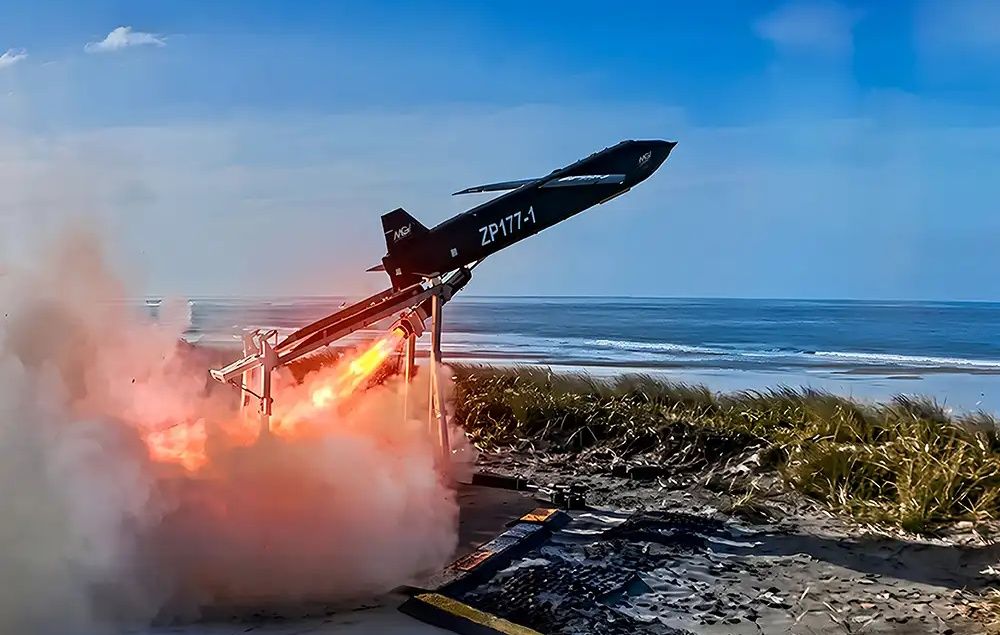
The single-use platform, classified as a "one-way effector," is deployed directly from mobile ground vehicles using a rocket-assisted launch setup. During launch, a detachable rocket booster provides the initial acceleration required to get the aircraft airborne. Once the drone reaches operational velocity, the rocket booster detaches automatically, allowing an onboard propulsion system consisting of twin turbojet engines to assume control for the duration of the flight.
According to specification details released by the company, the TigerShark is capable of reaching top speeds of 750 kilometers per hour (466 mph) with a maximum operational range of 900 kilometers (559 miles). The aircraft features a spacious modular payload bay capable of carrying up to 300 kilograms (661 pounds) of specialized equipment. This flexible payload arrangement allows the drone to be configured for a broad spectrum of mission profiles, including direct warhead delivery and electronic warfare disruption operations.
A central feature of the TigerShark is its ability to operate inside heavily contested environments where electronic warfare systems attempt to deny or distort satellite navigation. While the drone utilizes standard GPS for routing during uninhibited conditions, it incorporates a secondary, dual-technology guidance architecture designed to maintain precise target targeting even in environments where GPS signal access is completely blocked or actively spoofed.
This autonomous backup guidance mechanism combines inertial navigation technology with specialized optical terrain-mapping software. The inertial navigation system calculates the drone's position based on motion, orientation, and speed measurements gathered continuously from the launch location. Concurrently, the terrain-mapping system scans the landscape beneath the aircraft, comparing real-time visual readings with programmed geographic route data to make automated flight adjustments and ensure the platform stays on course.
MGI Defence designed the drone specifically for salvo deployment strategies, where multiple aircraft are launched simultaneously from a single mobile ground vehicle. By firing the systems in swarms, operators can saturate enemy air defense networks, overwhelming tracking systems through simultaneous high-speed approaches from multiple angles to ensure mission completion against defended or distant targets.
The platform was created in response to tightening defense procurement budgets and the high cost of conventional precision strike weapons. MGI Engineering optimized the TigerShark for rapid manufacturing and simplified assembly, offering an economical alternative to high-cost intermediate-range cruise missiles like the Tomahawk or Storm Shadow. The company noted that the system enables military forces to engage distant targets with speed, precision, and autonomy without requiring satellite connections or continuous human piloting.
First showcased to defense industry stakeholders at the DSEI exhibition in 2025, the TigerShark is slated to become commercially available starting in October 2026. MGI Defence plans to manufacture the system within the United Kingdom at its Oxfordshire facilities and will scale up production during the final quarter of 2026 to supply domestic requirements and export orders to friendly foreign governments under official licensing agreements.
Sources
Written by
The Company Wire
Inside the companies building what’s next. Reporting on startups, technology, funding and the people shaping them.