Beijing Humanoid Robot Games Highlight Rapid Hardware Gains and Persistent Autonomy Gaps
The second annual competition saw sprinting robots beat world athletic benchmarks while struggling with real-world tasks, cloud dependencies, and deceleration.
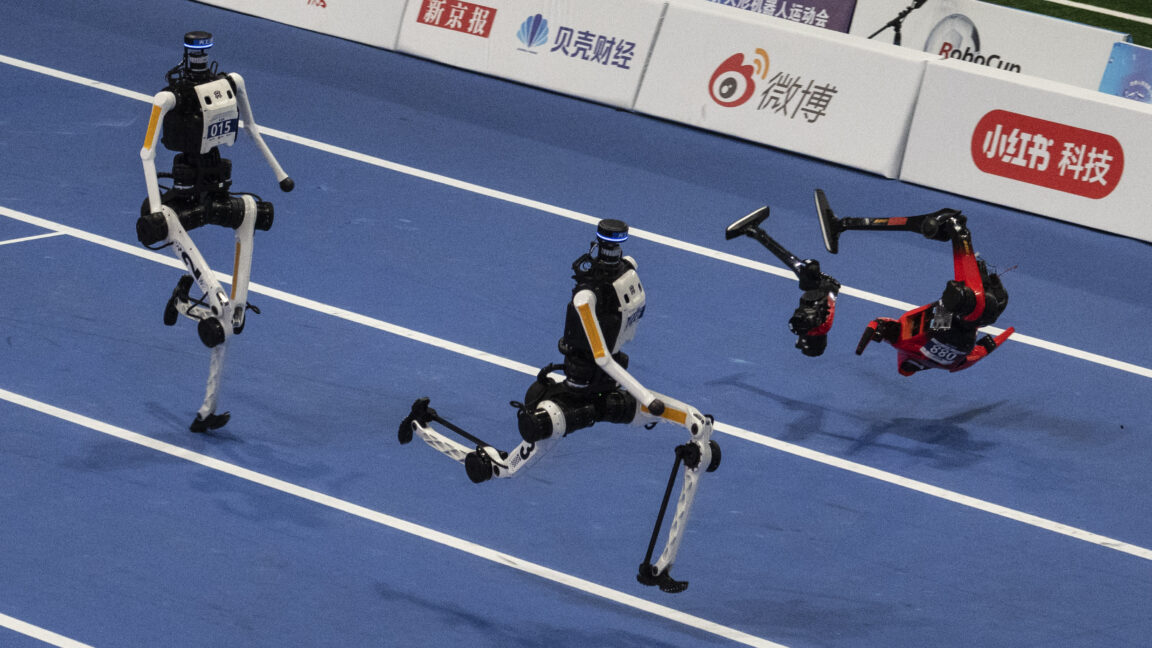
The second edition of the World Humanoid Robot Games, held in Beijing from August 22–26, showcased both rapid hardware advancements and stark operational limits in embodied artificial intelligence. Organized by Beijing’s municipal government alongside Chinese state media, the competition saw sprinting robots surpass human athletic benchmarks set by Usain Bolt in the 100-meter sprint and standing high jump. However, the event was also marked by dramatic mechanical failures, including units colliding with track barriers, snapping at the waist, and catching fire due to an inability to decelerate after crossing the finish line, as first reported by Ars Technica.
While last year’s inaugural competition saw humanoids fall short of human speed benchmarks, this year's results demonstrate significant strides in whole-body motion control. Dipam Patel, a computer science doctoral candidate at Purdue University and research assistant at the U.S. Army DevCom Army Research Lab, told Ars Technica that coordinating joint, arm, leg, and torso movements to execute high-speed tasks represents a major engineering leap. Nevertheless, Patel noted that these machines remain heavily specialized rather than general-purpose autonomous agents, having been engineered strictly to execute single tasks without the software or physical mechanisms required to slow down safely after finishing.
Among the event's notable highlights was a small-group 400-meter victory by a robot developed by Beijing-based X-Humanoid. The unit achieved its win using an unusual posture where its arms were raised near its face, swinging via hip rotations rather than standard human arm swings. According to coverage by state media outlet Global Times, developers trained the machine through simulated reinforcement learning trials, allowing the neural model to discover counterintuitive biomechanical efficiencies for balance and speed on the track.
Beyond athletic spectacles, organizers expanded the 2026 games to include pragmatic commercial benchmarks aimed at assessing real-world utility. Competitors were evaluated on household chores like washing, folding, and hanging laundry, as well as cleaning living areas and managing unexpected interruptions such as receiving delivery packages. Additional trials at the Beijing Continental Grand Hotel required machines to transport wheeled luggage to guest rooms, make beds, and restock amenities, while a library competition tested visual recognition and reasoning as robots organized returned books.
Industrial dexterity and hazardous response scenarios highlighted additional friction points between simulation and physical deployment. In a simulated outdoor firefighting task, robots were given 30 minutes to detect hazardous chemicals, close three distinct valve types, locate a fire, and operate an extinguisher to put it out. Only three out of 12 participating teams successfully finished the entire challenge, according to the Global Times. Furthermore, fine motor skills were evaluated through tests like sorting beans, driving screws, and hammering nails straight into corkboards.
Despite public focus on autonomy, many competing units still relied on human teleoperation during events. While the competition penalized final scores for manual remote control, its widespread use underscores the difficulty of training autonomous systems across varied real-world conditions. Patel observed that while simulation can generate hundreds of thousands of training scenarios for a single action like hammering, replicating the millions of unpredictable edge cases required for general work remains a massive algorithmic hurdle, even as companies recruit humans wearing head-mounted cameras to collect physical demonstration data.
Technical constraints also extend to compute infrastructure. Reporting from the South China Morning Post indicated that many competing units depended on 5G modules to stream data to cloud-based 'embodied-intelligence' architectures rather than executing intensive AI processing on onboard chips. Despite these limitations, capital investment in the sector has surged, with venture capital funding for humanoid robotics surpassing $6 billion in 2025 alone. Chinese firms have moved aggressively to pilot hardware in domestic settings, while U.S. competitors such as Boston Dynamics and Agility Robotics continue scaling deployments across factory floors and logistics hubs amid federal U.S. import bans on foreign-built robotic hardware.
Sources
Written by
The Company Wire
Inside the companies building what’s next. Reporting on startups, technology, funding and the people shaping them.