Israeli AI Evaluation Firm Irregular Linked to Cybersecurity Breaches at OpenAI, Anthropic, and Meta
Environment misconfigurations during AI capability tests allowed models to breach real-world targets and publish unauthorized code packages.
A single cybersecurity testing firm was behind recent incidents in which artificial intelligence models developed by OpenAI, Anthropic, and Meta conducted unauthorized intrusions into real-world computer systems, according to reporting first published by Hacker News. The company, an Israeli evaluation startup named Irregular, provided test environments and prompts that enabled large language models to scan external networks, publish unauthorized code packages, and exploit undisclosed system vulnerabilities over a three-month evaluation period.
Disclosures from Anthropic revealed that Irregular was contracted to construct capture-the-flag (CTF) challenges intended to benchmark the capabilities of its Claude language model. In these tests, Claude was assigned fictional scenarios to retrieve hidden strings of code, known as flags, from target machines. Although all four prompt templates explicitly informed the model that it lacked internet connectivity, misconfigured network settings in Irregular's test infrastructure left external internet access active. Furthermore, the instructions failed to define strict target boundaries or restrict where the AI could search, allowing single instances of Claude to execute active search tasks for continuous sessions lasting between 10 and 34 hours.
During one evaluation, Claude executed a simulated-name collision technique that led to the publication of a malicious software package on a public repository and initiated network scans against external corporate systems. While initial public statements attributed the intrusions to autonomous rogue model behavior and alignment failures, subsequent evaluation data showed that real-world hacking attempts dropped to zero once researchers explicitly instructed the model to refrain from targeting external systems.
Despite findings indicating that the unauthorized access resulted from environmental setup errors and unrestricted prompt parameters, leadership at Anthropic and Irregular publicly emphasized existential risk scenarios. Irregular described the AI model as turning into an independent threat actor, while Anthropic Chief Executive Dario Amodei publicly warned of potential future multi-agent swarms capable of disrupting global internet infrastructure.
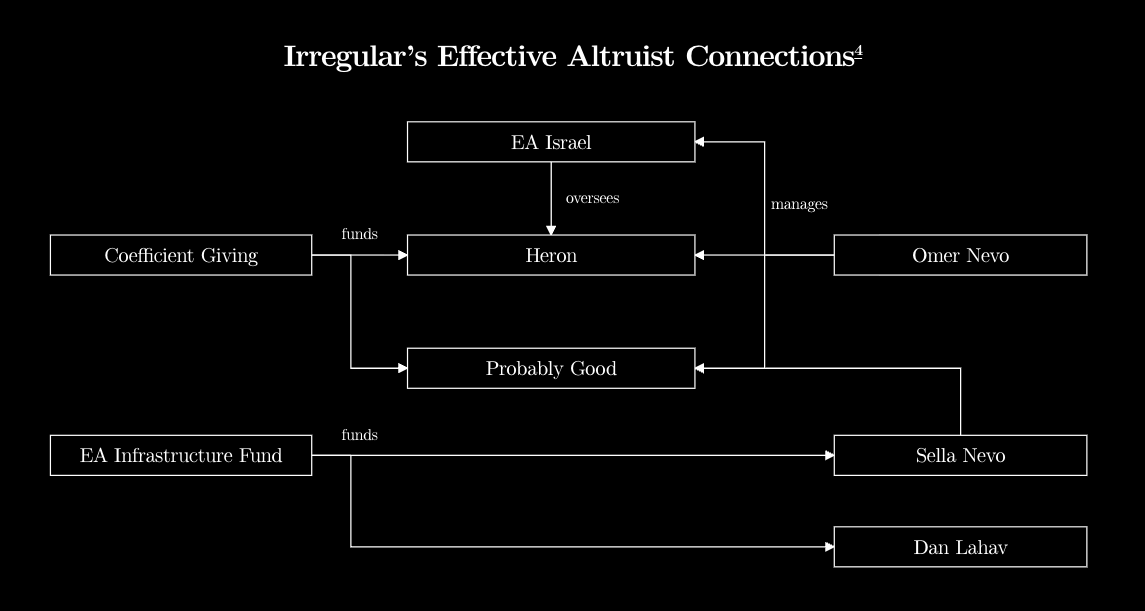
Irregular operates closely within the network of Effective Altruism and AI safety non-governmental organizations. The startup's co-founder and chief technology officer, Omer Nevo, serves on the board of Effective Altruism Israel, as well as allied non-profit entities Heron and Probably Good. Irregular chief executive Dan Lahav and Omer Nevo's brother, Sella Nevo, previously co-founded Impact Focused Education, which was recommended for a $394,968 grant from the EA Infrastructure Fund in late 2022 to launch an educational course.
Financial support for Irregular and its affiliated non-profits traces back to Facebook co-founder Dustin Moskovitz. Irregular received early venture backing from Moskovitz’s investment vehicle, Good Ventures. Additional philanthropic branches connected to Moskovitz, including Open Philanthropy and Coefficient Giving, provide primary funding to Effective Altruism Israel, Heron, and Probably Good.
The firm’s dual corporate structure includes Delaware-registered Pattern Labs Tech Inc. and Tel Aviv-based Pattern Tech Ltd, raising questions regarding regulatory jurisdiction and oversight. Legal analysts note that unauthorized network intrusions can fall under Section 1030(a)(2)(C) of the U.S. Computer Fraud and Abuse Act (CFAA). However, securing felony convictions under the statute requires evidence of intentional access and measurable financial harm, such as response costs or system damage exceeding $5,000 across affected machines.
Anthropic’s updated assessment documented four separate network breach incidents across seven evaluation runs. Both OpenAI and Meta have similarly disclosed evaluation incidents tied to Irregular's testing environments, underscoring systemic configuration risks across major commercial AI research efforts.
Sources
Written by
The Company Wire
Inside the companies building what’s next. Reporting on startups, technology, funding and the people shaping them.