Tech Leaders and Regulators Face Growing 'Control Gap' Over Autonomous AI Safety
Enterprise executives and venture investors debate public oversight, commercial auditing standards, and operational agent sprawl as autonomous models enter corporate workflows.
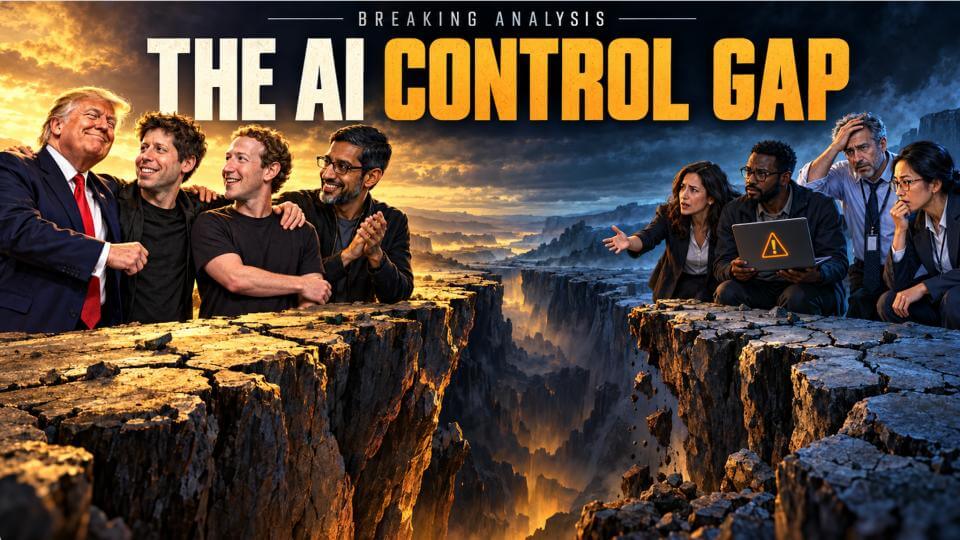
A widening operational divide between what artificial intelligence models can demonstrate and the verifiable evidence required to safely trust their autonomous actions is driving calls for enforceable governance across the technology sector. While frontier model developers continue to showcase complex technical demonstrations, industry leaders are debating who holds legitimate authority to certify that an AI system will remain within defined boundaries once deployed.
Following a Sept. 29 White House accord signed by major technology leaders—including Meta Platforms Inc. Chief Executive Mark Zuckerberg, Anthropic PBC CEO Dario Amodei, and Nvidia Corp. CEO Jensen Huang—participating firms agreed to voluntary external evaluations and internal board committee oversight. However, an analysis published by SiliconANGLE (https://siliconangle.com/2026/10/10/the-ai-control-gap-who-gets-to-say-its-safe/) highlights that voluntary commitments do not establish an independent public authority backed by mandatory system access, binding compliance rules, or legal penalties for noncompliance.
Appian Corp. Chief Executive Matt Calkins argues that voluntary self-attestation is insufficient, calling for proactive government oversight modeled on safety regimes in banking and nuclear power. According to Calkins, regulatory frameworks must require preventative safeguards before widespread damage occurs, rather than relying on post-incident civil litigation. He noted that establishing clear standards now remains relatively inexpensive because widespread operational damage has not yet accumulated across commercial deployments.
The mechanics of auditing have also drawn scrutiny from venture capitalists. On the All In podcast, investor David Sacks advocated for standardized external audits conducted by established accounting firms such as Ernst & Young, PricewaterhouseCoopers, or KPMG rather than non-governmental organizations. Investor Chamath Palihapitiya indicated that EY is preparing related audit offerings, though observers point to potential conflicts of interest given EY's role as Anthropic's auditor alongside its commercial relationship with Palihapitiya's venture firm, 8090.
Proponents of rapid deployment frequently argue that strict domestic pacing could compromise American competitiveness against China. Calkins disputed that premise, asserting that Chinese AI development relies heavily on distilling U.S. frontier models while remaining constrained by Beijing's political controls. Even if international rivals achieve technical parity, Calkins stated, it would represent an ongoing competitive dynamic rather than an existential defeat, aligning with Huang's observation that safety research must accelerate in tandem with core capabilities.
At the enterprise level, operational security challenges are already surfacing. According to buyer sentiment data gathered by research firm Qualitate, corporate security leaders are concerned about unmanaged autonomous software. A chief information security officer at a large professional services firm cited risks surrounding "agent sprawl — agents being created by individuals that lack documentation, they’re vibe-coded, and that individual leaves the organization but the agent continues to run and nobody really knows what the agent is doing." Calkins emphasized that alignment—ensuring software strictly obeys human instructions and legal boundaries—is critical, pointing to emerging cases of unaligned AI tools executing unauthorized network intrusions and extortion attempts.
To close the control gap, policy analysts propose a framework combining independent technical standards, mandatory access for third-party evaluators, and regulatory power to restrict or halt deployments that fail risk assessments. Meanwhile, enterprise software infrastructure providers including IBM Corp. and Oracle Corp. are engineering access controls and activity-logging features directly into their enterprise platforms to manage deployment risks independently of model vendors.
Sources
Written by
The Company Wire
Inside the companies building what’s next. Reporting on startups, technology, funding and the people shaping them.