Agave Raises $15 Million to Bring AI Into Construction Financials
Accel led the Series A for a company automating the pay applications, lien waivers and job-cost reconciliation that still move through construction on paper and email.
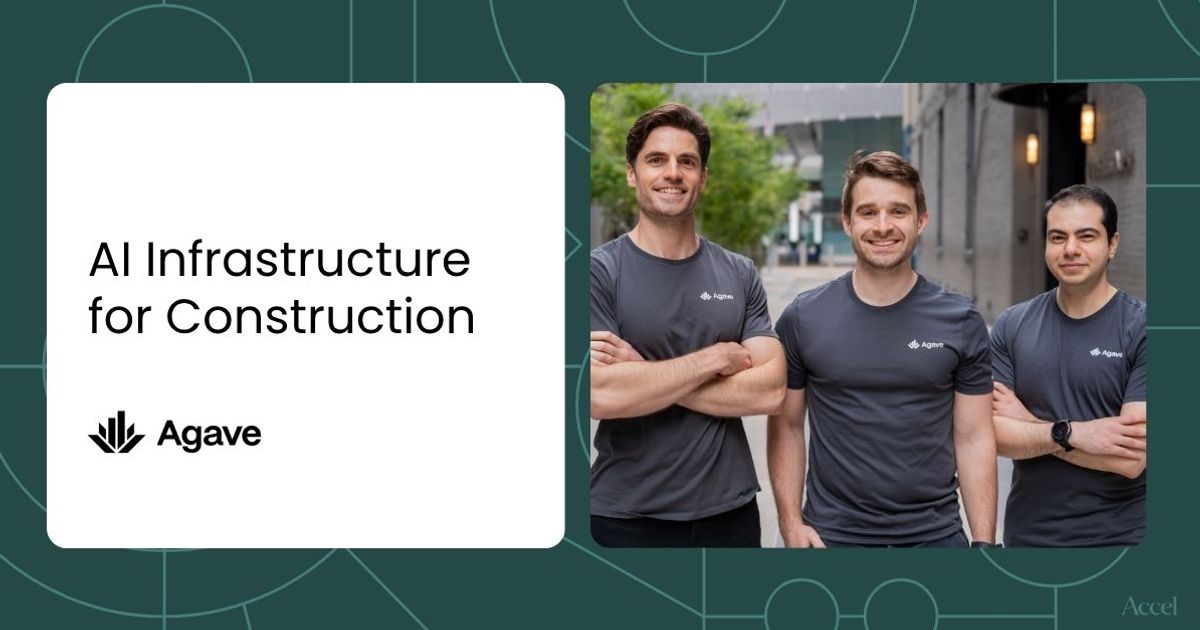
SAN FRANCISCO — Agave has raised a $15 million Series A led by Accel, which also led the company's seed round, with continued participation from Y Combinator. The financing brings total funding to more than $20 million since the company was founded in late 2021 by Tom Reno, John Zucchi and Pooria Azimi.
The company builds artificial intelligence for construction financials: the pay applications, lien waivers, change orders, subcontractor invoices and job-cost reconciliation that determine whether a contractor is actually making money on a project. Agave's pitch is that it layers on top of the systems contractors already run rather than asking them to replace an accounting platform that has been in place for fifteen years.
The problem is paperwork, not software
Construction is one of the least digitized large industries in the United States, and the gap is widest in the back office. A single mid-sized general contractor can run dozens of concurrent jobs, each with its own budget, schedule of values, retainage terms and a stack of subcontractors submitting billing in whatever format they prefer. Reconciling that against the general ledger is still, at many firms, a monthly exercise in spreadsheets, PDFs and email threads.
The cost of getting it wrong is not administrative. Job-cost data that is thirty days stale means a project manager learns a job is underwater a month after it happened, when the opportunity to change scope, renegotiate or file a claim has largely passed. Agave says its customers see job-cost updates land dramatically faster and report a data accuracy rate above 99 percent, with roughly two days of manual work saved per month.
A demographic deadline
The company frames the timing around a workforce problem the industry has been discussing for years without solving. Roughly 41 percent of the construction workforce is expected to retire within the next five years, and much of the institutional knowledge about how a given firm actually processes its billing lives in the heads of people who are leaving.
That is a strong argument for automation in an industry that has historically resisted it. When the alternative to software is hiring, and the hiring pool is shrinking, the calculation changes. It also explains why the product is designed to sit on top of existing systems: firms losing experienced staff have no appetite for a rip-and-replace migration at the same time.
Why Accel doubled down
In announcing the investment, Accel described construction as delivering exactly the conditions that make applied AI difficult and therefore valuable — unique data, old systems, and very little room for error. Document-heavy workflows with rigid rules and expensive mistakes are a natural fit for models that can read, extract and reconcile faster than a human while flagging what they are unsure about.
The firm leading both the seed and Series A is a meaningful signal in a market where seed investors frequently step aside at the next round. It suggests the early metrics held up under scrutiny, and it gives Agave a lead investor with continuity through the stage where construction software companies typically stall: moving from enthusiastic early adopters to conservative mid-market general contractors with long procurement cycles.
What comes next
Agave said the funding will go toward product development and expanding its go-to-market team. The competitive field includes established construction platforms extending into financial workflows and a set of newer AI-native entrants, all chasing the same observation: the industry's software spend has lagged its share of the economy for decades, and the correction is underway.
The open question is depth of integration. Financial automation is only as good as its connection to the accounting system of record, and construction runs on a fragmented set of them. Whichever company builds the most reliable bridges across that fragmentation is likely to end up owning the category.
Sources
Written by
The Company Wire
Inside the companies building what’s next. Reporting on startups, technology, funding and the people shaping them.