Antora Energy Raises $550 Million to Expand Thermal Battery Production
The industrial energy company plans to manufacture more systems that store renewable electricity as high-temperature heat and dispatchable power.
SAN JOSE, Calif. - Antora Energy has raised $550 million in Series C financing to expand production of thermal batteries for factories and data centers. The substantial capital injection, co-led by G2 Venture Partners and Eclipse, underscores a growing urgency within the private sector to solve the intermittency problems inherent in renewable energy. Joining the lead firms were a roster of high-profile investors including Ribbit Capital, Salesforce Ventures, Activate Capital, and John Doerr. The financing represents a major commitment to a sector that has historically struggled to attract the scale of funding typically reserved for software enterprises or traditional infrastructure.
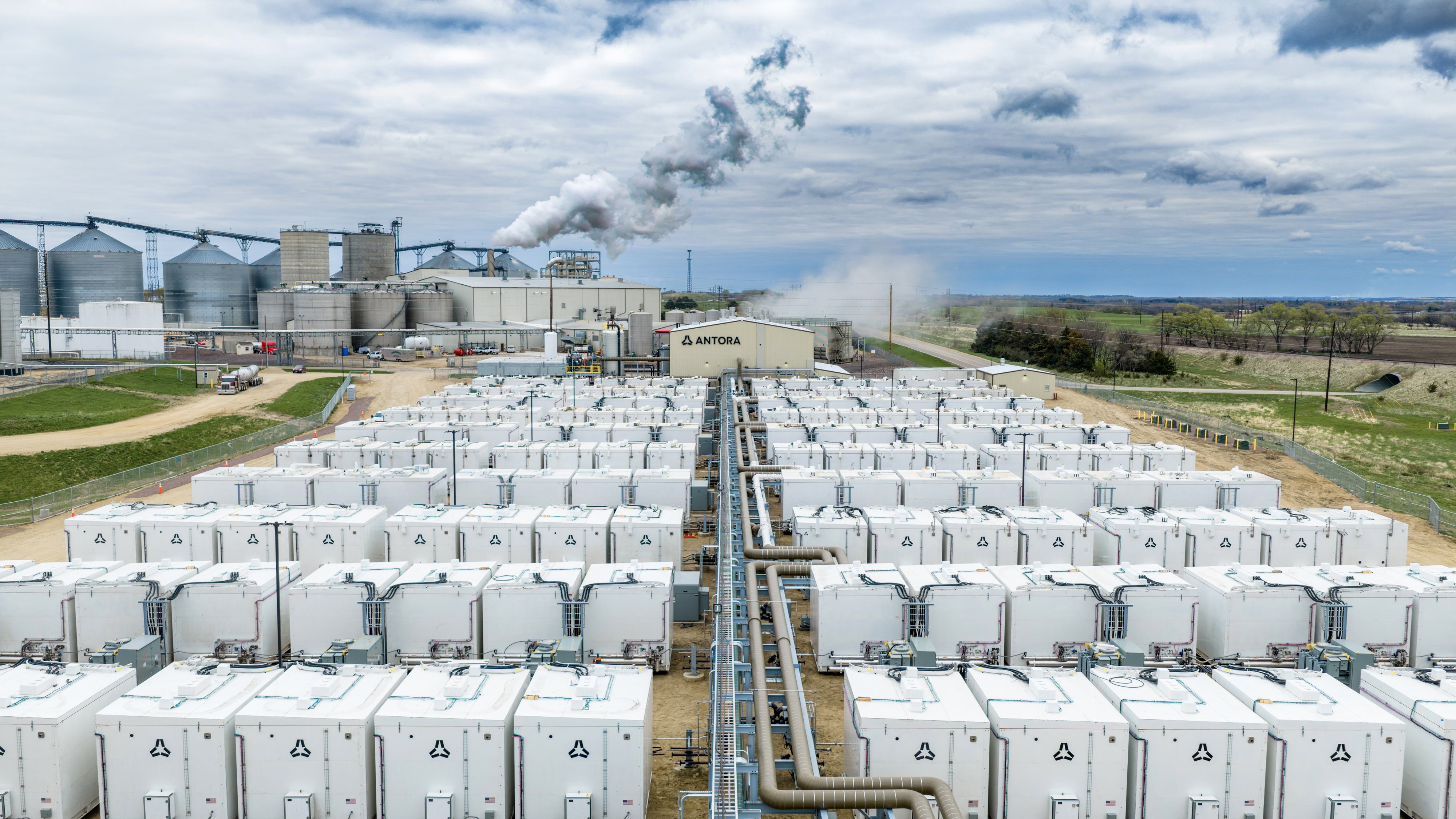
The San Jose company stores electricity as heat in blocks of solid carbon, a design intended to provide round-the-clock energy from low-cost renewable generation without relying solely on electrochemical batteries. By utilizing carbon, a material available in vast quantities and capable of withstand extreme temperatures, the company bypasses many of the supply chain bottlenecks associated with lithium-ion or other rare-metal chemistries. Antora’s technology functions by taking excess power from wind and solar farms when it is cheapest and storing it as high-temperature heat inside its thermal modules, which can then be dispatched as needed to meet industrial or commercial demand.
Customers can use that stored energy directly for industrial processes or convert it back into electricity via thermophotovoltaic cells. This dual-purpose utility is a critical differentiator in an energy market where heating needs often exceed electricity consumption in heavy manufacturing. The ability to provide high-temperature heat, which is essential for industries like steel, cement, and chemical production, positions Antora as a potential bridge for sectors that have found it difficult to transition away from fossil fuels due to the intense energy requirements of their core operations.
Industrial heat is a large source of emissions and a difficult sector to electrify. Unlike domestic heating, which can often be managed with heat pumps, industrial applications frequently require temperatures exceeding 1,000 degrees Celsius. Traditional grid infrastructure and standard battery technologies often fail to provide the necessary thermal density or the sustained discharge duration required for these heavy-duty cycles. Analysts have noted that decarbonizing this specific niche is essential for meeting global climate targets, as industrial heat accounts for a significant portion of the global greenhouse gas footprint.
Beyond heavy industry, Antora is also targeting data centers seeking dependable power as AI increases electricity demand. The rapid proliferation of large language models and intensive compute clusters has put unprecedented strain on the electrical grid, leading operators to seek alternative ways to ensure uptime while meeting corporate sustainability goals. Thermal storage can be especially useful where customers need both heat and electricity or where grid capacity is constrained, providing a localized buffer that reduces the immediate burden on utility providers.
The Series C will support manufacturing capacity and deployment of larger projects. To date, many thermal storage concepts have been limited to pilot operations or small-scale demonstrations. The scale of this $550 million round suggests a transition toward industrial-scale output. For the firm to succeed, it must prove that its manufacturing processes can be automated and scaled to meet the requirements of multinational corporations. This necessitates moving from artisanal assembly to a streamlined production line capable of delivering consistent battery modules at high volumes.
Investors are backing Antora's ability to turn readily available materials into durable energy infrastructure. The choice of solid carbon is particularly notable as it lacks the volatility and degradation issues prevalent in many chemical storage solutions. As the cost of renewable generation continues to fall, the economic bottleneck has shifted from energy production to energy storage. The round lands as infrastructure-focused climate technology becomes a primary interest for venture firms looking for physical assets that can achieve long-term defensibility.
However, the path to widespread adoption remains fraught with operational challenges. The company must demonstrate that its systems can be manufactured quickly, operated safely and financed at competitive lifetime costs. In the capital-intensive world of energy hardware, the margins for error are significantly narrower than in software. Safety is of paramount importance when dealing with ultra-high temperatures, and long-term durability must be proven through rigorous field testing to satisfy the risk-aversion of industrial procurement officers.
Large energy projects move through permitting, construction and customer approval cycles that can be slower than software adoption. This systemic inertia is a known barrier in the energy sector, where project timelines are measured in years rather than months. Antora’s ability to navigate these bureaucratic hurdles while maintaining its technological edge will be a critical factor in its long-term survival. The complexity of integrating hardware into existing factory footprints or new data center builds requires high levels of coordination and engineering precision.
External economic factors also play a role in the pace of deployment. Cheaper natural gas or alternative storage technologies could affect project economics. If fossil fuel prices remain low, the financial incentive for heavy industry to switch to thermal batteries may diminish despite the environmental benefits. Furthermore, competitors in the long-duration energy storage space, including liquid air, pumped hydro, and alternative iron-air batteries, are all vying for a slice of the same market, creating a crowded field for capital and customer attention.
The next proof will be repeat commercial orders and operating data showing that customers receive reliable heat or power at the promised cost. While the initial Series C funding provides a significant runway, sustaining momentum will require proof of performance in varied climates and operational environments. Transparency in operating data will be essential to convince lenders and insurance firms to provide the project finance necessary for massive multi-unit deployments.
The success of Antora Energy is often viewed as a bellwether for the broader thermal storage category. If a company backed by major names like John Doerr and Salesforce Ventures can successfully bridge the gap between innovation and commercial infrastructure, it may signal a new era of investment in heavy industrial decarbonization. The industry will be watching closely to see if the solid-carbon design can deliver on its promise of low-cost, high-reliability energy without the environmental costs of past solutions.
Ultimately, the goal is to transform the way heavy industry interacts with the electrical grid. By turning renewable energy into a storable, dispatchable commodity, Antora aims to decouple the timing of wind and solar production from the timing of industrial consumption. This capability is the missing link in creating a fully modernized energy network that does not sacrifice industrial output for ecological gains.
As the San Jose manufacturing facility begins to scale, the focus will shift from theoretical efficiency to practical throughput. The deployment of the first few large-scale commercial units will serve as the true test of Antora’s engineering. If these systems can provide the reliable, high-temperature heat that furnaces and boilers have traditionally drawn from combustion, the market potential for the firm's carbon-based storage could be vast, representing a fundamental shift in global energy infrastructure.
Sources
Written by
The Company Wire
Inside the companies building what’s next. Reporting on startups, technology, funding and the people shaping them.