Groq Raises $650 Million to Expand Its AI Inference Cloud
The chip company is rebuilding and scaling its cloud business after a major licensing and talent agreement with Nvidia.
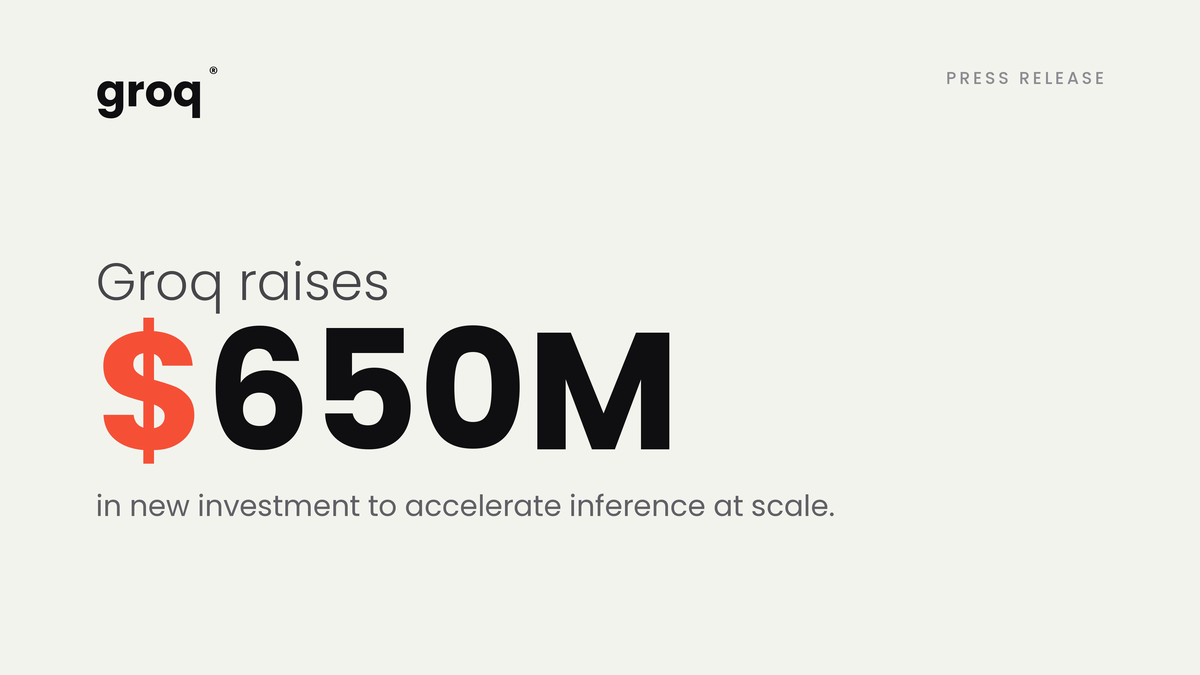
SAN FRANCISCO, Calif. - Groq has raised $650 million in growth capital to expand GroqCloud, its service for running artificial intelligence models. Disruptive and Infinitum led the financing, which arrives as the San Francisco-based company restaffs after a broad licensing and talent agreement with Nvidia. The substantial injection of capital positions the startup to scale its specialized infrastructure at a moment when the industry is shifting focus from the computationally intensive training of models to the efficient, high-speed deployment of those models in production environments.
The core of Groq’s technical proposition lies in its Language Processing Units, or LPUs, which are chips specifically optimized for inference. Inference is the stage of the artificial intelligence lifecycle when a previously trained model generates answers, summarizes text, or takes autonomous actions based on user inputs. While the industry has long relied on general-purpose graphics processing units for both training and inference, Groq has argued that specialized architectures are required to meet the performance demands of real-time applications where latency is a critical factor for usability.
Groq markets its hardware and the associated cloud service around fast, predictable performance, targeting developers who require low-latency responses for their applications. As the generative AI market matures, businesses are increasingly moving beyond experimental prototypes to customer-facing tools, such as chatbots and automated assistants, where a delay of even a few seconds can degrade the user experience. By focusing on deterministic processing speed, Groq aims to capture a segment of the developer market that prioritizes consistency over the broad versatility offered by traditional high-end processors.
The recent agreement with Nvidia represented a significant pivot for the organization, altering its internal structure and technical roadmap through licensing and talent transfers. Such agreements are rare in the highly competitive semiconductor space and often indicate a complex alignment of interests between a dominant incumbent and a specialized challenger. Despite these organizational changes, the Nvidia agreement left Groq's cloud business operating independently, allowing the company to maintain its direct relationship with the software developers and enterprises utilizing its proprietary hardware.
This fresh infusion of capital gives Groq a critical opportunity to add computing capacity and recruit employees while global demand for inference continues to grow exponentially. Scaling a cloud service requires massive capital expenditures, particularly when the underlying hardware is proprietary and must be manufactured and deployed in high-volume data center environments. For Groq, the funding serves as a necessary buffer to manage the costs of expanding its physical footprint while simultaneously rebuilding a team to support its independent cloud strategy following the Nvidia deal.
The successful close of this round also signals that institutional investors see significant value in Groq beyond the specific technology assets licensed to the world's dominant AI chip supplier. While Nvidia currently controls the vast majority of the market for AI compute, venture capital and growth equity firms are increasingly betting on specialized architectures that might perform specific tasks more efficiently than a general-purpose GPU. The support from Disruptive and Infinitum suggests a belief that Groq's LPU architecture can carve out a sustainable niche in the broader AI ecosystem.
Despite the new funding, Groq remains in a challenging position as it navigates a market defined by extreme competition and high barriers to entry. Building specialized chips and the cloud infrastructure necessary to deliver them at scale is an prohibitively expensive endeavor with long development cycles. The company is not only competing against Nvidia’s massive research and development budget but also against the internal silicon efforts of major cloud service providers like Amazon, Google, and Microsoft, all of whom are developing their own inference-optimized chips.
The competitive landscape is further crowded by a wave of well-funded startups, each attempting to optimize different parts of the AI stack. As these players improve their own inference products, Groq must continuously demonstrate that its performance advantage is significant enough to justify the migration of workloads to a new platform. Industry analysts have frequently noted that raw speed is only one part of the equation; software compatibility, ease of integration, and the robustness of the developer ecosystem are equally vital for long-term adoption in the enterprise sector.
To succeed, Groq must show that its technical advantages in latency and throughput translate directly into reliable customer growth. It is not enough to have a fast chip if the company cannot obtain sufficient manufacturing capacity or secure the data center space required to host its services. The global supply chain for high-end semiconductors and the physical infrastructure of power and cooling for AI data centers are currently under extreme strain, placing additional pressure on smaller firms to secure the resources needed for expansion.
The current financing round effectively extends the company's runway for this crucial test of its business model. Groq can now afford to invest heavily in its hardware deployments, refine its software toolkits, and bolster its customer support teams to better compete with larger rivals. This period of expansion will be vital for clarifying the company’s post-agreement strategy and proving that its cloud-first approach can achieve the scale necessary to be profitable in a low-margin cloud hardware environment.
The ultimate measure of Groq’s success will be the sustained and growing usage of the GroqCloud platform. In the current market, venture-backed companies are being scrutinized not just for their technical innovation, but for their ability to generate recurring revenue and build a loyal user base. While a fast chip is a clear technical achievement and valuable intellectual property, a truly lasting business in the cloud era requires a dependable platform, a comprehensive suite of developer tools, and healthy unit economics.
As the company looks toward its next phase, the focus will likely remain on its ability to execute its deployment roadmap without further organizational disruptions. The AI hardware sector is notorious for its high failure rate, and the move from a research-driven chip designer to a full-service cloud provider is a fraught transition. Observers will be watching closely to see if Groq can convert its latest $650 million in capital into a defensible market share before the next generation of competing hardware arrives on the market.
Sources
Written by
The Company Wire
Inside the companies building what’s next. Reporting on startups, technology, funding and the people shaping them.