Socket Raises $60 Million to Secure Open-Source Software in the AI Era
The software supply-chain company reached a $1 billion valuation as faster code generation increases the number of outside packages entering applications.
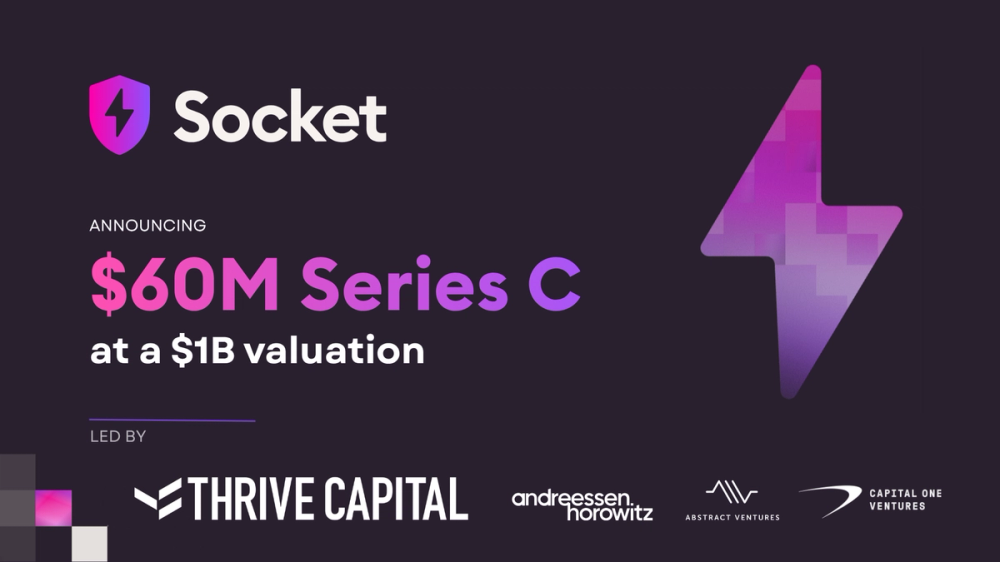
SAN FRANCISCO, Calif. - Socket has raised $60 million in Series C financing at a $1 billion valuation to expand its platforms for software supply-chain security, reflecting a surge in investor interest as artificial intelligence accelerates the speed of code development. Thrive Capital led the funding round, which also saw participation from notable venture capital firms Andreessen Horowitz and Abstract Ventures, alongside the strategic investment arm Capital One Ventures. This latest capital infusion brings Socket's total funding to approximately $125 million, cementing its status as a significant player in the developer tools sector at a time when the broader software industry is grappling with new security vulnerabilities introduced by automated programming tools.
The company was founded in 2020 by Chief Executive Feross Aboukhadijeh, an experienced open-source developer who recognized a fundamental shift in how modern software is built. Today, most applications are not written entirely from scratch; instead, they are assembled like mosaics using thousands of pre-existing open-source packages. While this reliance on modular code has allowed for unprecedented development speed, it has also created a massive attack surface. Socket was established to examine these open-source packages and dependencies, providing a layer of scrutiny that traditional security tools often miss by focusing purely on the code written in-house rather than the third-party components that support it.
Socket’s core technology operates by analyzing the behavior and maintenance signals of software packages to identify malicious code, compromised accounts, and risky changes before a dependency ever reaches a production environment. By looking for red flags such as unauthorized network access, attempts to read sensitive environment variables, or unusual telemetry, the platform attempts to stop supply-chain attacks in their tracks. This proactive approach distinguishes the company from older signature-based security scanners that typically only identify known vulnerabilities after they have been documented in public databases, a process that is often too slow to prevent modern breaches.
The current product suite includes a sophisticated software firewall designed to block harmful packages during the development and continuous integration phases. This allows engineering teams to set policies that automatically prevent the introduction of untrustworthy code into a project. To integrate seamlessly into a developer's existing workflow, Socket also provides specialized tools for GitHub and various code editors, browser extensions for vetting packages on public registries, and certified patches that allow developers to fix vulnerable dependencies without waiting for official updates from maintainers who may be unresponsive.
The timing of the Series C round coincides with a transformative shift in the industry: the rise of the AI-augmented developer. As firms increasingly adopt AI coding assistants to generate software, the volume of code being produced has reached record levels. However, analysts have noted that these AI agents, while efficient, may inadvertently select and include open-source packages that a human developer has never personally reviewed or vetted. This capability creates a new class of risk where the speed of generation outpaces the ability of security teams to perform manual audits, making automated gatekeeping an essential component of the modern enterprise stack.
Cybersecurity experts have observed that attackers are already exploiting this increased velocity through techniques such as typosquatting, where malicious packages are given names nearly identical to popular legitimate ones. Other threats include account takeovers of trusted maintainers and the creation of packages that appear to offer useful utility while secretly functioning as data-stealing malware. Because AI models are trained on vast datasets that may include these malicious or deprecated libraries, there is a legitimate concern that AI-suggested code could serve as a delivery mechanism for supply-chain compromises if not properly monitored.
In response to these evolving threats, Socket has expanded its technical coverage to address workflows involving AI agents and Model Context Protocol tools. This ensures that even when a machine is making the decision to add a new package to a codebase, the same rigorous behavioral analysis is applied. The company's philosophy centers on the idea that security must operate at the precise moment a dependency enters a project. By positioning its tools at the point of entry, Socket aims to shift security 'left' in the development lifecycle, preventing threats from becoming embedded in an application's architecture where they are significantly harder to remediate.
The broader market for software supply-chain security has seen a flurry of activity as large enterprises realize that a single compromised dependency can lead to widespread data breaches. High-profile incidents in recent years have demonstrated that even sophisticated organizations are vulnerable to upstream code tampering. As a result, the sector is transitioning from a niche technical concern to a boardroom priority. For an organization like Capital One, which participated in the round, the interest is likely driven by the need to secure vast financial infrastructures that rely heavily on open-source ecosystems while maintaining a rapid pace of digital innovation.
Despite the successful funding round and the reach of its current product line, Socket faces several execution risks inherent to the security industry. The most significant challenge is the need to keep pace with a massive and constantly changing open-source ecosystem that spans multiple languages and platforms. As new packages are published at a rate of thousands per day, the computational overhead required to analyze and index them in real-time is substantial. Any lag in detection could result in a window of vulnerability that sophisticated threat actors could exploit.
Another critical hurdle for Socket will be maintaining a low false-positive rate. Developers are historically sensitive to tools that slow down their work or generate excessive alerts. If a security platform flag too many legitimate updates as potentially suspicious, it risks becoming 'shelfware' that engineers bypass to meet deadlines. The company’s ability to use the new $60 million in capital to refine its analysis engine and ensure that it only interrupts development for genuine threats will be a key determinant of its long-term adoption across large engineering organizations.
The $1 billion valuation reflects the high conviction among investors that the intersection of AI and software security will be one of the most lucrative areas of the next decade. By positioning itself as the automated gatekeeper for the AI era, Socket is betting that the demand for its services will scale proportionally with the increase in software output. The company intends to use the new financing to significantly expand its team and further develop its platform capabilities, potentially looking toward deeper integrations with the full lifecycle of AI-driven development.
Industry observers will be watching closely to see how Socket competes with incumbent security providers who are also racing to add supply-chain features to their broader platforms. While Socket has a first-mover advantage in focusing specifically on behavioral analysis of dependencies, the consolidation of security tools remains a prevalent trend in the enterprise. To justify its unicorn valuation, the company will likely need to prove that its specialized focus provides a depth of protection that general-purpose security suites cannot match.
Moving forward, the focus for Socket remains on scaling its infrastructure to support increasingly complex development environments. As more companies move toward autonomous coding agents, the role of an independent, automated validator becomes more vital. The company's mission is founded on the belief that while AI can write code, it cannot always be trusted to manage the security implications of its choices. By providing the tools to bridge this gap, Socket aims to ensure that the AI-driven gains in developer productivity do not come at the expense of industrial-grade security.
The successful Series C round led by Thrive Capital marks a new chapter for Socket as it attempts to move from a high-growth startup to an essential pillar of global software infrastructure. With the backing of top-tier venture firms and a clear mandate to address the risks of the AI era, the company is well-positioned to lead the conversation on how software is built and secured for years to come. Whether it can maintain its lead in an increasingly crowded and technically demanding market will be the primary question for its next phase of growth.
Sources
Written by
The Company Wire
Inside the companies building what’s next. Reporting on startups, technology, funding and the people shaping them.