Adobe Integrates Creative Tools and Firefly Generative AI Into Slack
The new Adobe for Slack extension allows teams to generate images, video, and documents inside chat channels while navigating EU synthetic media tracking rules.
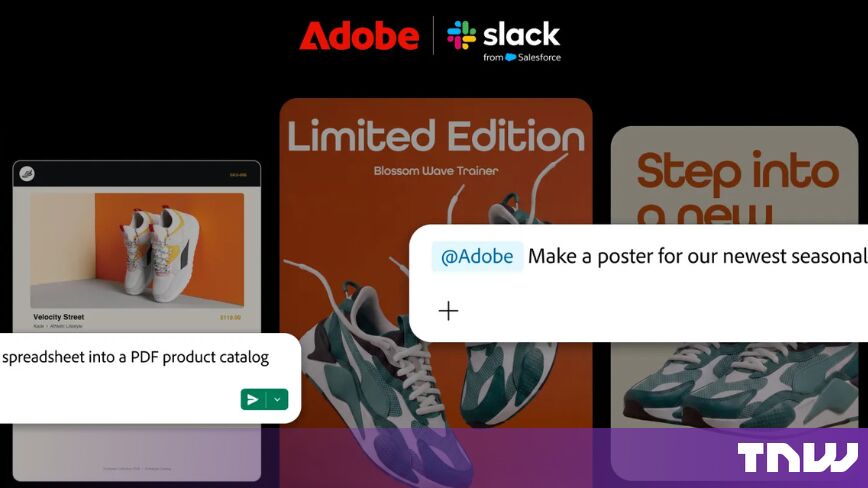
Adobe Inc. has introduced a deep software integration with Slack, embedding its suite of creative and productivity tools directly within the workplace messaging platform. The extension, called Adobe for Slack, enables enterprise teams to generate, modify, and distribute media assets directly inside chat channels, leveraging generative artificial intelligence models and professional editing tools, as first reported by The Next Web.
Under the new arrangement, users can issue text commands to Slackbot, which analyzes the context of active channel conversations, digital canvases, and uploaded files. The automated assistant then routes tasks to Adobe applications including Firefly, Photoshop, Premiere, and Acrobat, alongside more than 70 other connected software applications. Digital Trends previously reported that Slackbot is capable of examining the topic, aesthetic style, and mood of a conversation to search Creative Cloud asset libraries and produce context-aware content.
Accessing the integration requires customers to maintain separate enterprise subscriptions across both platforms. Organizations must operate on Slack’s Business+ or Enterprise+ plans while holding a distinct commercial license with Adobe. The release represents Adobe’s third major conversational application integration, following a recent launch for OpenAI’s ChatGPT and an existing integration for Anthropic’s Claude, with a Google Gemini edition currently in development.
The product launch arrives as European regulators tighten requirements regarding synthetically generated visual and auditory media. Beginning August 2, 2026, Article 50 of the European Union AI Act requires tech vendors and content creators to embed machine-readable metadata into all AI-generated images, videos, and audio files.
Adobe occupies a central position in the emerging compliance framework as a founding participant in the Content Authenticity Initiative and co-author of the Coalition for Content Provenance and Authenticity (C2PA) standard, which underpins Content Credentials. Formal transparency guidance from the European Commission explicitly cites C2PA as a practical implementation capable of meeting statutory compliance standards.
Under European guidelines, content provenance tags must maintain durability against format conversions, minor edits, and tampering, while remaining interoperable across digital software ecosystems. However, transmitting generated media through conversational software presents technical hurdles, as C2PA metadata manifests can be stripped if downstream applications lack C2PA support or execute basic file re-saves.
It remains unverified whether provenance credentials created through Adobe for Slack remain intact when assets are downloaded from chat windows and transferred into external software, such as presentation decks. To prevent metadata loss during file handling, regulatory guidance recommends combining C2PA metadata with invisible digital watermarking—an approach adopted by OpenAI alongside Google’s SynthID technology—while platforms like YouTube rely on automated detection systems to infer AI origin at the point of distribution.
Sources
Written by
The Company Wire
Inside the companies building what’s next. Reporting on startups, technology, funding and the people shaping them.