Salesforce Launches Five AI Agents for Communications Providers
Agentforce for Communications targets telecom sales, service, billing and field operations with industry-specific workflows.
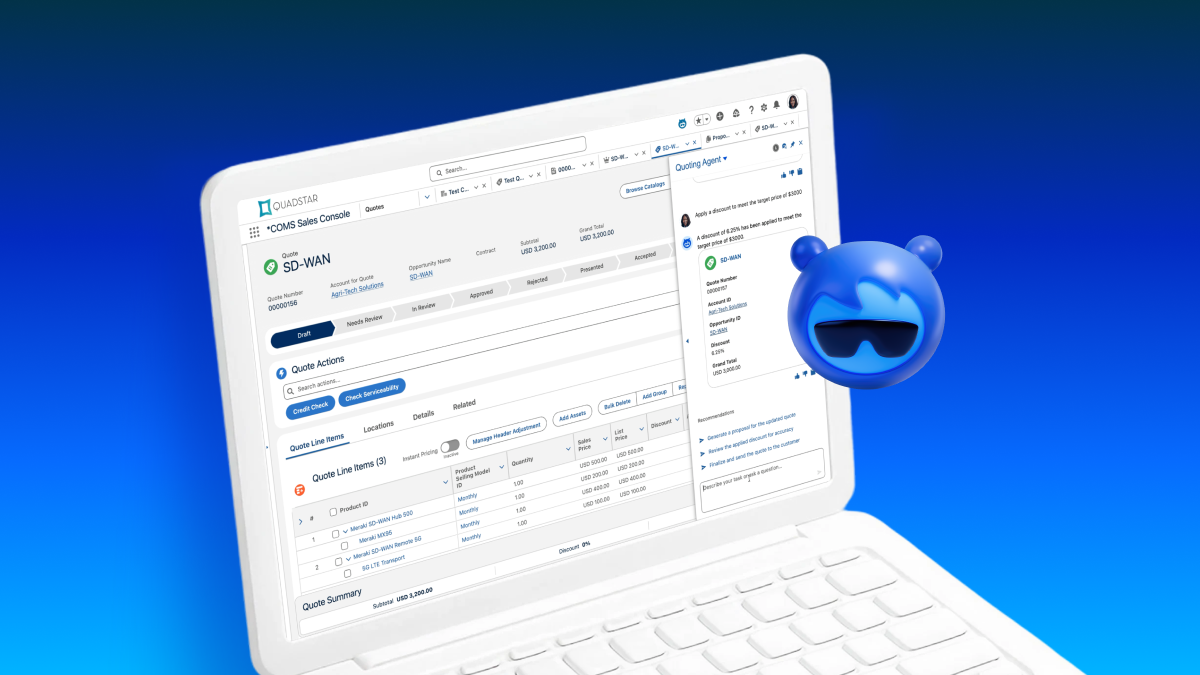
SAN FRANCISCO, Calif. - Salesforce has launched Agentforce for Communications, a group of five prebuilt artificial intelligence agents for telecommunications and media providers. The product is designed to automate industry-specific work across sales, customer service, billing and field operations instead of requiring companies to adapt a generic agent to every process. The move represents a calculated shift for the enterprise software giant as it maneuvers to provide more verticalized applications for its generative AI platform, targeting the unique structural demands of the global connectivity and media sectors.
The suite of agents aims to address specific pain points in the telecommunications ecosystem, where high customer acquisition costs and low margins often put pressure on operational efficiency. By introducing prebuilt agents, Salesforce is attempting to lower the barrier to entry for large-scale telcos that have historically struggled with the long development cycles required to build custom AI models. These agents are engineered to integrate directly into existing environments, allowing for a more immediate application of autonomous intelligence within highly specialized workflows.
The specific agents can support tasks such as identifying churn risk, guiding a customer through service changes, helping a technician surface an upgrade opportunity and coordinating billing questions. By focusing on these high-frequency touchpoints, Salesforce is positioning its technology as a bridge between back-office data and front-line customer experience. The ability to scan customer sentiment and usage patterns to predict churn, for example, allows providers to act proactively rather than reacting after a service has been cancelled.
These tools are built on Salesforce's communications products and Headless 360 architecture, giving them access to approved customer and service information. This technical foundation is critical, as it allows the agents to decouple the user interface from the underlying business logic, providing flexibility across mobile apps, websites, and partner portals. By anchoring the agents in the Headless 360 framework, Salesforce ensures that the AI is not operating in a vacuum but is instead grounded in a unified view of the customer relationship.
Prebuilt workflows can shorten implementation time in an industry with complex product catalogs and legacy systems. Telecommunications providers often struggle with architectural debt, where decades of mergers and technical evolutions have left them with fragmented infrastructure. Salesforce’s approach suggests that by providing the logic and the connectors out of the box, they can bypass much of the custom code that typically stalls enterprise AI deployments in this sector.
However, telecommunications data is often divided among network, billing, customer relationship and partner platforms. An agent can provide a complete answer only if those systems are synchronized and permissions are enforced consistently. In many legacy environments, the data required to answer a single billing query might reside in three different databases, and if the Agentforce layer cannot achieve seamless real-time synchronization, the reliability of the automated output could be compromised.
Industry analysts have noted that the effectiveness of vertical AI depends heavily on data hygiene and API maturity. For a communications provider, the challenge lies in ensuring that the AI agent has the same level of access to network performance data as it does to the CRM status. Without this deep integration, the agent risks providing generic responses that fail to account for localized service issues or specific contract terms, undermining the core promise of the verticalized product.
Salesforce says the tools can help employees focus on higher-value interactions while agents handle repetitive steps. This is a common refrain in the enterprise AI space, where the goal is often described as augmentation rather than replacement. In the context of a call center or a field service dispatch, if an agent can handle routine data entry or plan upgrades, the human worker is theoretically free to manage complex troubleshooting or high-value relationship building.
Providers should test that claim against real exceptions, including disputed charges, service outages and vulnerable customers. These situations require accurate records and a clear path to a person, not a longer automated conversation. In the telecommunications sector, where service reliability is considered a public utility in many regions, a failure to escalate specialized or sensitive issues to a human representative could lead to regulatory scrutiny or significant brand damage.
The launch extends Agentforce into another vertical market where specialized data and rules matter. Salesforce has been aggressively expanding its industry-specific clouds, recognizing that a one-size-fits-all approach to software is increasingly insufficient for sectors with heavy regulatory or technical requirements. By entering the communications space with these five agents, the company is competing for a central role in the digital transformation budgets of some of the world’s largest infrastructure operators.
Success will depend on measurable improvements in resolution time, retention and technician productivity. For field operations specifically, the ability for an agent to provide real-time guidance to a technician on a customer’s premises could transform the site visit from a cost center into a margin-growing opportunity. If the agent can accurately identify that a customer’s hardware is obsolete and suggest a compatible upgrade, it creates value for both the provider and the end user.
Companies should also monitor whether automated upselling creates customer frustration. There is a fine line between a helpful recommendation and an intrusive sales tactic, particularly when delivered through an autonomous interface. In the communications industry, where customers already express high levels of sensitivity to pricing changes and contract renewals, the deployment of AI-driven sales tactics must be handled with significant care.
Ultimately, a useful industry agent must balance revenue goals with service accuracy and consent. The deployment of Agentforce for Communications will serve as a bellwether for how effectively autonomous agents can navigate the complexities of a highly regulated, data-intensive industry. As these agents move from pilot programs to full production, the market will be looking for concrete evidence that they can reduce overhead without degrading the quality of the customer experience.
Moving forward, Salesforce is likely to continue this verticalization strategy across other sectors such as healthcare and manufacturing. The communications launch underscores the company's belief that the future of enterprise software is not just in providing the platform, but in providing the intelligent blueprints specific to each industry. The ability of Salesforce to maintain data integrity and security across these diverse environments will be the litmus test for its broader AI ambitions.
Sources
Written by
The Company Wire
Inside the companies building what’s next. Reporting on startups, technology, funding and the people shaping them.