UiPath Unveils Cartographer to Map Enterprise Workflows for Autonomous AI
At its annual conference in Las Vegas, founder Daniel Dines outlined LLM limits as the enterprise automation vendor crossed $2 billion in ARR.
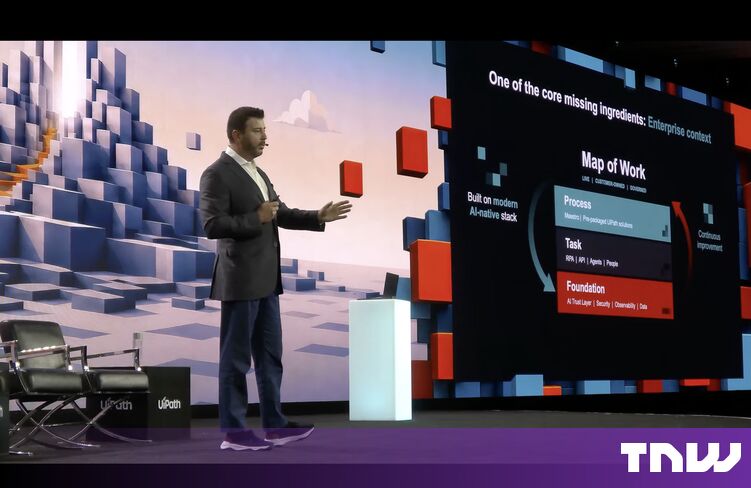
At UiPath's annual FUSION conference at the Wynn Las Vegas, Chief Executive Officer and founder Daniel Dines unveiled a new application designed to generate detailed operational blueprints for enterprise artificial intelligence deployment. Dubbed UiPath Cartographer, the tool aims to address reliability and context gaps in large language models by creating what the company calls a "Map of Work," according to reporting from The Next Web (https://thenextweb.com/news/uipath-cartographer-daniel-dines-fusion-keynote). The product announcement comes as the enterprise automation software provider crossed $2 billion in annual recurring revenue across more than 10,000 customers.
During his keynote presentation, Dines outlined three structural constraints that prevent large language models from operating independently within corporate workflows: a lack of real-world consequence for actions, a reliance on memory rather than true learning, and probabilistic execution in business environments that require deterministic exactness. "Without this manual, nobody will really succeed in deploying autonomous AI that we can trust to make decisions and understand how we actually work," Dines told attendees.
Cartographer operates by ingesting standard operating procedures, documentation, process-mining diagrams, and workflow charts. The software can also question subject-matter experts, capture screen recordings, and analyze process deviations to build an initial workflow map. UiPath's coding agents then generate automations from that foundation, while human supervisors review decisions and log corrections into a "Decision Ledger" to feed new exceptions back into the system.
UiPath announced that its proprietary coding agents are now generally available, alongside native platform integrations for third-party tools including Claude Code, Cursor, Codex, and Antigravity. Cartographer is available immediately, though UiPath did not disclose pricing terms. Dines highlighted the company's growth trajectory over the past decade, noting that its first user conference in London in 2016 drew approximately 100 people when the company generated between $3 million and $4 million in annual recurring revenue.
Enterprise customers at the conference addressed both the scale and the reliability thresholds of automation deployments. Kei Yamamoto of Sumitomo Mitsui Financial Group (SMBC)—identified by Dines as one of UiPath's largest clients—said the bank has automated more than six million hours since 2017, freeing roughly 3,000 employees for other roles. However, Yamamoto highlighted compound error risks in AI pipelines, noting that a three-step workflow with 90 percent accuracy per step drops to approximately 73 percent end-to-end reliability, an outcome he characterized as unacceptable for accounting. SMBC plans to test Cartographer next.
Other enterprise executives echoed the demand for high precision before deploying autonomous systems. William Abrams of medical supplier Medline noted that 73 percent accuracy is unusable for hospital clients that require 99 percent reliability. Discussing autonomous software validation on UiPath Test Cloud, Forrester analyst Diego Lo Giudice emphasized that automated "dark testing factories" must establish operational trust rather than pursuing autonomy for its own sake.
Closing his address, Dines cautioned executives against reducing entry-level hiring amid generative AI adoption, noting that junior staff must learn from human mentors rather than automated tooling. Dines also distributed copies of his AI-assisted book, The Work That Remains, which he produced using Anthropic's Claude as a sparring partner and OpenAI's ChatGPT for editorial review.
Sources
Written by
The Company Wire
Inside the companies building what’s next. Reporting on startups, technology, funding and the people shaping them.