Dell Pivots Private Cloud Toward Disaggregated Architecture to Support AI Demands
The hardware provider is decoupling compute and storage to give enterprises multi-hypervisor flexibility and dense storage for artificial intelligence workloads.
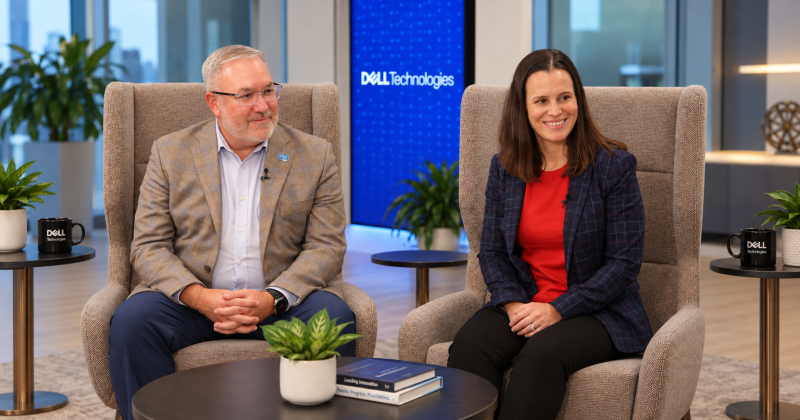
Enterprise data centers are reshaping their private cloud architectures as artificial intelligence workloads drive organizations to balance escalating public cloud costs, data sovereignty, and infrastructure flexibility. As reported by SiliconANGLE (https://siliconangle.com/2026/09/23/rivate-cloud-ai-infrastructure-dell-powerstore-dellrethinkingprivatecloudmeta/) during Dell Technologies Inc.’s 'Rethinking Private Cloud for the Age of Intelligence' broadcast on theCUBE, enterprises are increasingly shifting away from traditional hyperconverged infrastructure (HCI) toward disaggregated architectures that separate compute and storage resources while maintaining centralized operational management.
Dave Vellante, chief analyst at theCUBE Research, noted during the event that modern private cloud adoption centers on economics, control, and AI sovereignty. Caitlin Gordon, vice president of product at Dell Technologies, stated that enterprise decision-makers prioritize cost control, platform openness, and operational simplicity as changing application requirements place new pressures on IT budgets.
While traditional hyperconverged systems unified compute and storage to simplify deployments, they frequently required organizations to purchase unneeded capacity when scaling an individual resource. Disaggregated models decouple those layers so compute and storage can grow independently. Jodey Hogeland, global PowerStore evangelist at Dell, explained that this model offers organizations the financial flexibility to scale compute or storage capacity dynamically without overprovisioning.
The disaggregated model also addresses broader changes across the virtualization market. Dell Private Cloud supports multiple operating environments, including VMware, Red Hat OpenShift, Nutanix, and Microsoft Azure Local, allowing organizations to run different environments across reusable hardware. Gordon noted that while the majority of current deployments continue to run VMware, enterprises increasingly seek the option to migrate or expand across alternative environments without overhauling underlying hardware.
To address storage demands from AI workloads, Dell highlighted its PowerStore Elite primary storage platform. The system operates in a 3-rack unit form factor and provides up to a 6:1 data reduction ratio while delivering triple the performance and triple the efficiency of prior generations, according to Dell. StorageReview.com editor Brian Beeler, who reviewed the system in the lab, noted that the chassis incorporates 40 E3 SSD bays, standard OCP network interface cards, and relocated NVRAM and battery backups within the controllers, freeing front-panel space to increase density.
To manage the complexity of separated compute and storage layers, Dell uses the Dell Automation Platform for lifecycle management and infrastructure validation. Gordon cited internal testing indicating up to a 66% time savings when managing Dell Private Cloud with automation compared with managing a traditional three-tier environment without automation tools. The architecture also allows targeted updates to storage, compute, or security patches rather than requiring updates across the entire stack.
System storage management also incorporates automated features, including Dynamic Node Affinity to direct volume placement and path selection based on workload conditions. Beeler noted that the Dell Automation Platform Orchestrator can deploy private cloud environments using configuration files and blueprints, enabling generalist administrators or service providers to manage storage environments without specialized personnel.
Sources
Written by
The Company Wire
Inside the companies building what’s next. Reporting on startups, technology, funding and the people shaping them.