Jeff Lindsay Unveils 9/UX, a Macintosh-Style Desktop for 9front
The open-source project maps classic spatial interface conventions to Plan 9 file systems and 9P protocols under an MIT license.
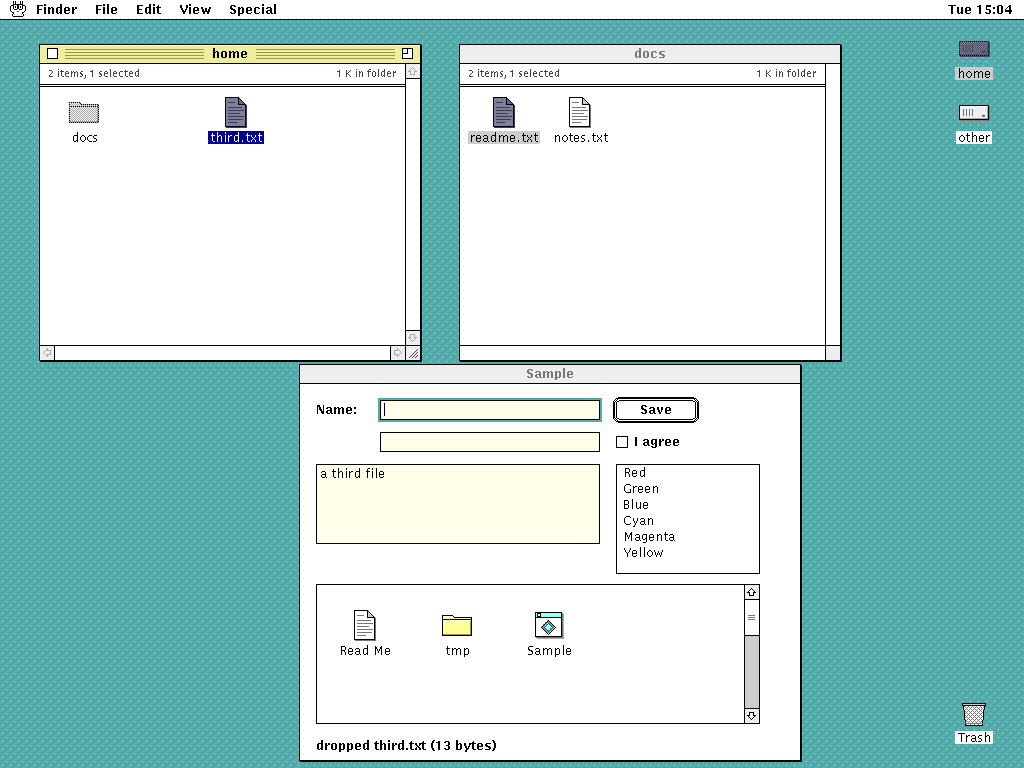
Developer Jeff Lindsay has released 9/UX, an open-source desktop environment designed for the 9front operating system that implements classic Macintosh and Apple A/UX user interface conventions using Plan 9 file abstractions, according to documentation published on progrium.github.io (https://progrium.github.io/9ux/).
The project introduces a spatial desktop and direct-manipulation controls while preserving Plan 9's defining architectural pattern: exposing system services, resources, and application states as synthetic file hierarchies managed via the 9P protocol. The software is released under the MIT license and is currently designated as version 0.1.
Lindsay specifies that 9/UX is neither an emulator, a Macintosh application binary interface layer, nor an A/UX reimplementation. Instead, it runs as native 9front software. Conventional 9front applications and standard rio window manager utilities—such as the acme and sam text editors, rc command shells, and nested rio instances—run unmodified alongside 9/UX applications on the same display.
The architecture relies on several interdependent components. Window management is handled by a modified fork of rio invoked with the -u flag, which adds a desktop surface layer, window title-bar chrome, a drag broker, and an active application menu bar exposed under /dev/ux; when run without the flag, the binary functions as stock rio. Application controls are supplied by libux, a toolkit that presents each program's user interface hierarchy as a 9P file tree, allowing external tools and shell scripts to inspect state or trigger actions by writing text commands to synthetic control files.
Desktop state and auxiliary services are split among specialized background daemons. A central daemon, uxd, mounts and organizes application control trees at /mnt/ux under configurable access policies. Desktop associations, spatial layouts, and mounted volumes are tracked by uxmeta using human-editable ndb configuration files. A resource file server, resfs, exposes icon, menu, dialog, and string resources at /mnt/res using formats inspired by classic ICN# and icl8 descriptors, while clipd keeps a typed clipboard synchronized with rio's native snarf buffer.
The Desktop file manager provides volume icons, spatial folder windows, duplicate commands, Get Info dialogs, and a Trash receptacle. Double-clicking documents launches programs through Plan 9's native plumber messaging daemon, and remote 9P file servers can be mounted directly as desktop storage volumes.
Visually, 9/UX combines Macintosh geometry with traditional Plan 9 color choices, using rio's selection yellow for title bars alongside acme's olive and cream tones against a grey-green desktop. The interface is drawn in whole pixels using a sixteen-color palette engineered to remain legible in monochrome. The project includes no proprietary Apple assets; all graphics are original, including a pixel-art rendering of the Plan 9 mascot Glenda created by Dan Fessler.
Lindsay's development workflow relies on h9, a tool that runs native 9front compilers, mk, and rio directly inside host environments without requiring a full virtual machine boot. The project documentation notes that because 9/UX is at version 0.1, internal interfaces and file protocol specifications remain under active development and are subject to breaking changes.
Sources
Written by
The Company Wire
Inside the companies building what’s next. Reporting on startups, technology, funding and the people shaping them.

