World Humanoid Robot Games Highlight Rapid Advancements in Sprinting and Dexterity
Robotics manufacturers in China demonstrated record-setting athletic feats and delicate manipulation tasks as the industry pushes toward real-world commercial automation.

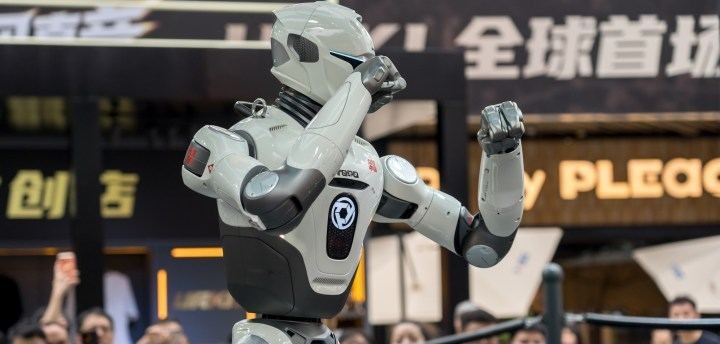
The second annual World Humanoid Robot Games concluded in Beijing on Aug. 26, showcasing rapid hardware and algorithmic advancements across the global robotics industry. First reported by Wired, the four-day event brought together more than 600 participating teams and over 2,000 machines from China and 15 other nations, serving as a proving ground for systems intended for commercial and industrial deployment.
Athletic competitions highlighted the physical capabilities of current humanoid designs. The Tiangong Ultra, built by the Beijing Humanoid Robot Innovation Center, completed a 100-meter sprint in 8.86 seconds and posted a 7.97-meter long jump. Another entry, dubbed Lightning and developed by smartphone manufacturer Honor, recorded a 9.47-second 100-meter run at the games following a 9.32-second pre-event trial. Both sprinting times surpassed the human world record of 9.58 seconds established by Usain Bolt. Robots also competed in table tennis against an Olympic champion, soccer, weightlifting, and boxing.
Industry observers attribute these athletic performances to improvements in high-power motor technology and simulation-based machine learning models. High-torque compact actuators allow humanoids to maintain dynamic stability at elevated speeds, a hardware trend led by companies such as Hangzhou-based Unitree, which recently completed an initial public offering. Simulation training enables algorithms to discover optimal movement strategies, often resulting in distinct, non-human running gaits, according to Brown University roboticist Stefanie Tellex.
Beyond feats of speed, organizers introduced practical skill challenges designed to assess object manipulation in everyday environments. Contests included connecting electrical cables into wall sockets, placing garbage into indoor bins, block construction, and picking up beans using tweezers. These tasks mirror industrial priorities in China, where companies are seeking to automate delicate assembly work across electronics manufacturing, automotive chassis wiring, and warehouse operations.
Robotics experts emphasized that fine-motor tasks present greater technical hurdles than high-speed locomotion. Citing Moravec’s paradox, Tellex noted that activities such as backflips are frequently easier to program than tasks requiring subtle tactile adjustments to counteract friction and slippage. While several event demonstrations relied on human teleoperation rather than full autonomy, researchers highlighted the growing precision of robotic end-effectors holding tools and handling small objects.
Commercial developers used the venue to showcase progress toward unassisted operation. Startup Galbot participated in a supermarket shelf-stocking competition and demonstrated an autonomous system capable of playing tennis against a human opponent, requiring real-time perception and rapid reflexive motion. Galbot representative Yvonne Yuan said the firm plans to advance its systems by tackling complex operational environments, moving "from structured environments toward more open, unpredictable real-world applications where robots need to understand, adapt, and collaborate with humans."
With China now home to more than 100 humanoid robotics manufacturers, the event reflects broader national investments in automated labor and advanced engineering. Carnegie Mellon University roboticist Chris Atkeson noted the strategic value of public enthusiasm for technological progress. "I think it is great that a country expresses excitement about science and engineering and has a positive view of a technological future," Atkeson said. "I am sorry it is not America."
Sources
Written by
The Company Wire
Inside the companies building what’s next. Reporting on startups, technology, funding and the people shaping them.