Margaret Hamilton, Software Engineering Pioneer and Apollo Flight Software Director, Dies at 90
The computer scientist who coined the discipline's name, engineered the Apollo 11 failsafe routines, and founded two software firms has died.
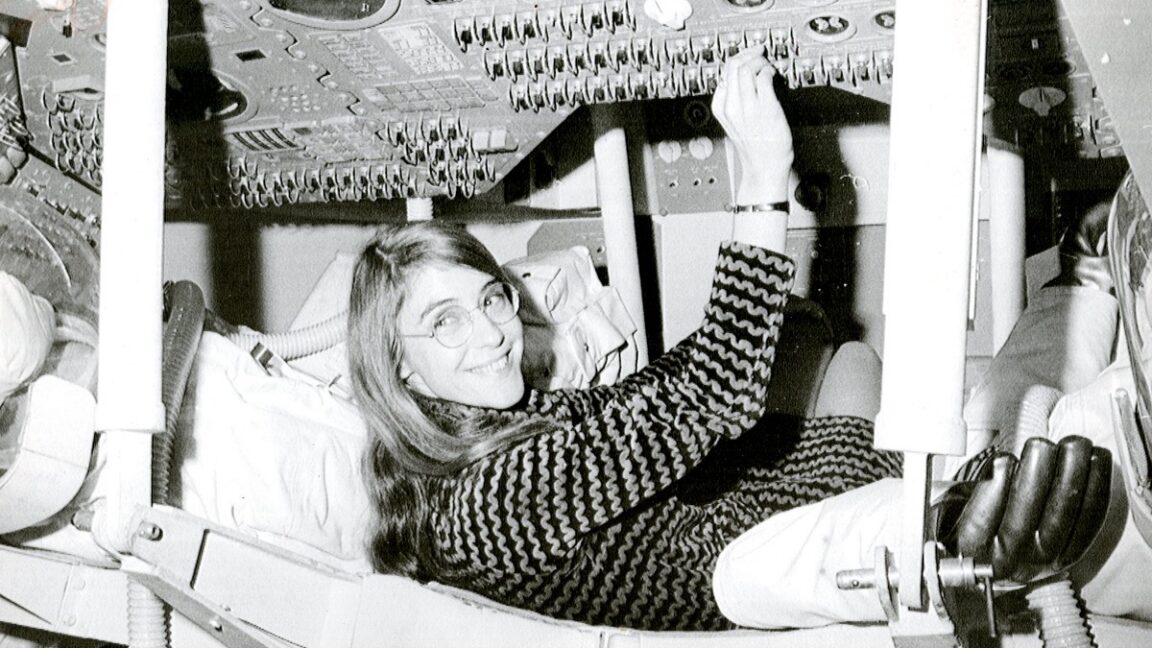
Margaret Hamilton, the computer scientist who coined the term "software engineering" and directed onboard flight software development for NASA's Apollo space program, died last week at age 90, Ars Technica reported (https://arstechnica.com/science/2026/10/r-i-p-margaret-hamilton-whose-code-saved-the-apollo-11-moon-landing/). Beyond her foundational work in real-time aerospace computing, Hamilton was a software entrepreneur who founded two commercial companies focused on error prevention and systems engineering.
Born in 1936 in Paoli, Indiana, Hamilton graduated from Earlham College in 1958 with a mathematics degree and a philosophy minor. She married James Cox Hamilton that year and took a position at the Massachusetts Institute of Technology, planning to work while he completed law school before pursuing her own doctorate in mathematics. At MIT, she worked for mathematician Edward Lorenz, programming an LGP-30 computer to model weather systems with differential equations—work that contributed to the emergence of chaos theory. With no formal computing curriculum available, Hamilton taught herself to program, occasionally editing binary code on paper tape by hand before training her successor, Ellen Fetter.
Hamilton moved in 1961 to MIT's SAGE project, writing software for a prototype XD-1 computer used by the U.S. Air Force to detect potential enemy aircraft. Her work decoding complex legacy programs led to a career-long focus on software reliability. In 1965, she became the first programmer and first woman hired by MIT's Instrumentation Lab to develop onboard guidance software for NASA's Apollo program, contributing to six lunar landing missions between 1969 and 1972. During this period, flight code was hardwired into core rope memory by New England textile workers who wove copper wires through magnetic cores, earning Hamilton the moniker "rope mother."
After her four-year-old daughter accidentally crashed a simulator by entering a pre-launch sequence during a simulated flight, Hamilton proposed adding safeguards against operational input errors. NASA leadership initially declined the change, but astronaut Jim Lovell made the same error on Apollo 8, wiping navigation data and requiring Hamilton's team to recover the information.
By 1968, Hamilton served as assistant director overseeing the Command and Service Module software team. She designed failsafe recovery mechanisms into the priority display interface routines, allowing the onboard computer to drop lower-priority tasks if processing demands exceeded real-time capacity. That architecture proved critical during the 1969 Apollo 11 landing: when radar input overloaded the guidance computer during Eagle's descent, the software bypassed nonessential tasks and maintained landing operations, preventing an abort.
"She was a software engineer at a time when that field was in its infancy, and she not only developed advanced code herself but also led a team in using that nascent technology to develop one of the most complex systems humanity had ever achieved," said Olivier de Weck, interim head of the MIT Department of Aeronautics and Astronautics.
After the Apollo program concluded and the Instrumentation Lab became Draper Laboratory, Hamilton remained until 1976, when she co-founded Higher Order Software. In 1985, she founded Hamilton Technologies, developing the Universal Systems Language (USL) to implement preventative systems architecture and defensive programming. Hamilton was awarded the Presidential Medal of Freedom in 2016, immortalized as a LEGO minifig in 2017, and commemorated by Google in 2019 with a Mojave Desert solar mirror portrait. She is survived by her daughter Lauren Hamilton, her son-in-law Richard Selesnick, two grandsons, four great-grandchildren, and three siblings.
Sources
Written by
The Company Wire
Inside the companies building what’s next. Reporting on startups, technology, funding and the people shaping them.