Bedrock Robotics Raises $270 Million for Autonomous Construction
The company founded by former Waymo leaders is moving its self-driving system from supervised job sites toward operator-less heavy equipment.
SAN FRANCISCO, Calif. - Bedrock Robotics has secured $270 million in Series B financing to accelerate the expansion of its autonomous technology for the construction industry, marking one of the most significant venture investments in heavy-equipment robotics this year. The funding round was co-led by CapitalG and the Valor Atreides AI Fund, with additional participation from a broad syndicate of investors including Xora, 8VC, Eclipse, Emergence Capital, and NVentures. This latest infusion of capital brings the San Francisco-based company’s total funding to more than $350 million, signaling strong institutional confidence in the application of self-driving systems to high-stakes industrial environments.
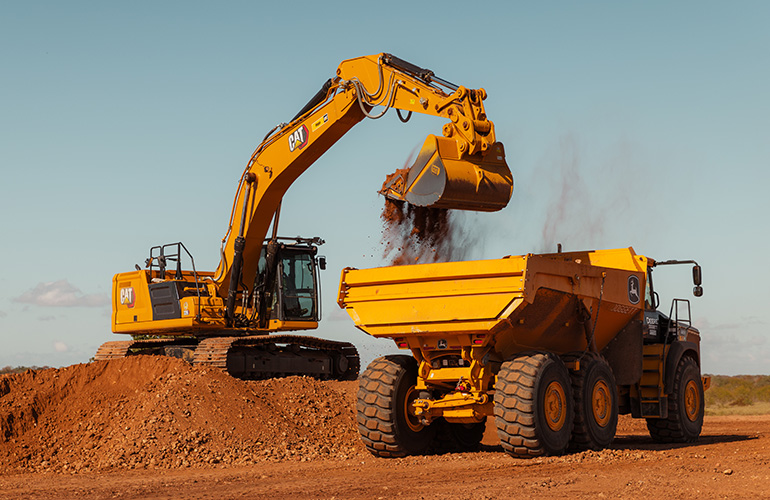
Bedrock specializes in the development of a sophisticated autonomy stack specifically engineered for excavators and other heavy machinery commonly utilized by large-scale contractors. Unlike original equipment manufacturers that require the purchase of entirely new autonomous units, Bedrock focuses on a hardware and software integration that can be installed on existing equipment. This approach allows construction firms to introduce automation across their current inventories, effectively bridging the gap between legacy diesel-powered fleets and the next generation of intelligent, digitized job site operations.
The company’s leadership draws heavily from the pioneering era of autonomous mobility, having been formed by veterans of Waymo’s self-driving program. This pedigree suggests a transfer of rigorous safety standards and sensor-fusion expertise from the world of passenger vehicles to the more confined, albeit more chaotic, world of heavy infrastructure. By moving from the public roadway to the construction site, the Bedrock team is applying years of experience in computer vision and path planning to a sector that has historically been slow to adopt high-tech intervention.
Modern construction is a massive global market currently grappling with a compounding series of macro headwinds, most notably a persistent shortage of skilled labor. As the aging workforce in specialized trades nears retirement, contractors are struggling to find qualified operators to meet demanding project schedules. The resulting labor gap often leads to expensive idle machinery, where multi-million-dollar assets sit unused due to a lack of staff. Bedrock’s technology aims to mitigate these limitations by providing a system that can take over repetitive or high-precision tasks, ensuring that equipment utilization remains high even amid labor volatility.
Beyond addressing workforce shortages, autonomous equipment offers the potential to significantly extend operating hours on critical infrastructure projects. While human operators are limited by fatigue and the necessity of shifts, a machine equipped with a reliable autonomy system could, in theory, maintain consistency throughout extended cycles. This increased uptime helps contractors complete more work with their available crews, allowing human staff to focus on complex site management and problem-solving while the autonomous units handle the bulk of material movement.
Industry analysts have noted that the controlled nature of construction job sites may offer a more immediate path to commercialization for autonomous systems than public roads. While a self-driving car must navigate unpredictable human drivers, pedestrians, and complex traffic laws, a construction site is a closed environment where access is strictly regulated. This relative isolation reduces some of the edge-case scenarios that have historically plagued the deployment of robotaxis, though it introduces a different set of physical challenges unique to heavy earthmoving.
Despite these advantages, the transition to heavy-equipment autonomy carries profound safety and liability requirements that Bedrock must navigate. Construction sites are dynamic environments that change on a daily, if not hourly, basis as earth is moved and structures rise. These zones often involve the close-proximity interaction of humans and multiple high-powered machines, frequently operating in conditions of poor visibility, dust, or inclement weather. To achieve widespread adoption, Bedrock’s system must demonstrate an impeccable safety record in these high-friction scenarios.
The competitive landscape for construction robotics is becoming increasingly crowded as both established equipment makers and specialized startups race to define the standard for site automation. Industry giants such as Caterpillar and Komatsu have spent years developing their own proprietary autonomous solutions, often deeply integrated into their hardware. To succeed, Bedrock must prove that its aftermarket, platform-agnostic approach is sufficiently robust to compete with the native systems being built by the world’s largest machinery manufacturers.
A critical hurdle for the company involves the integration of its technology into existing contractor workflows. Construction project management relies on tight coordination between disparate teams, and any delay caused by a malfunctioning or poorly integrated robotic unit can ripple through a project’s timeline, incurring massive costs. Bedrock’s engineering team is tasked with ensuring that its software not only drives the machine but also communicates effectively with the broader digital ecosystem of the modern job site.
The proceeds from the $270 million Series B will be used to fund a significant scale-up in engineering and field deployment. A primary objective for the company is move beyond supervised operations toward a model of truly operator-less excavator work on partner sites. This shift represents a major milestone in the evolution of the technology, moving from a human-in-the-loop safety configuration to a fully independent operational mode where the machine performs its duties without a person in the cab.
The company has indicated that its progress will be measured by several decisive milestones, including total safe operating hours, productive output per hour, and overall customer economics. For contractors, the decision to adopt Bedrock’s system will ultimately be a financial one; the system must provide a clear return on investment through lower costs per cubic yard of material moved or faster project completion times. The Series B funding provides the necessary runway to refine these metrics across a wider variety of geographic and geological conditions.
As Bedrock expands its footprint, the industry will be watching closely to see if the system performs as reliably in the field as it does in controlled demonstrations. The ability to handle the unpredictable 'long tail' of construction site anomalies—from unexpected underground utilities to shifting soil stability—will be the true test for the former Waymo engineers. If successful, Bedrock’s modular autonomy stack could provide the construction industry with its first practical, large-scale path to automation that does not require the wholesale replacement of existing equipment bases.
Looking forward, the success of Bedrock Robotics could serve as a bellwether for the broader industrial AI sector. As venture capital continues to flow into robotics companies that target specific, high-value vertical markets, the focus has shifted from general-purpose machines to task-specific automation. By targeting the excavator—the workhorse of the construction world—Bedrock is positioning itself at the center of a transformation that could redefine how global infrastructure is built and maintained in the decades to come.
Sources
Written by
The Company Wire
Inside the companies building what’s next. Reporting on startups, technology, funding and the people shaping them.