Salesforce Launches a Prepackaged Help Agent
Agentforce Help Agent is designed to deploy across service channels in minutes and charge customers only for completed resolutions.
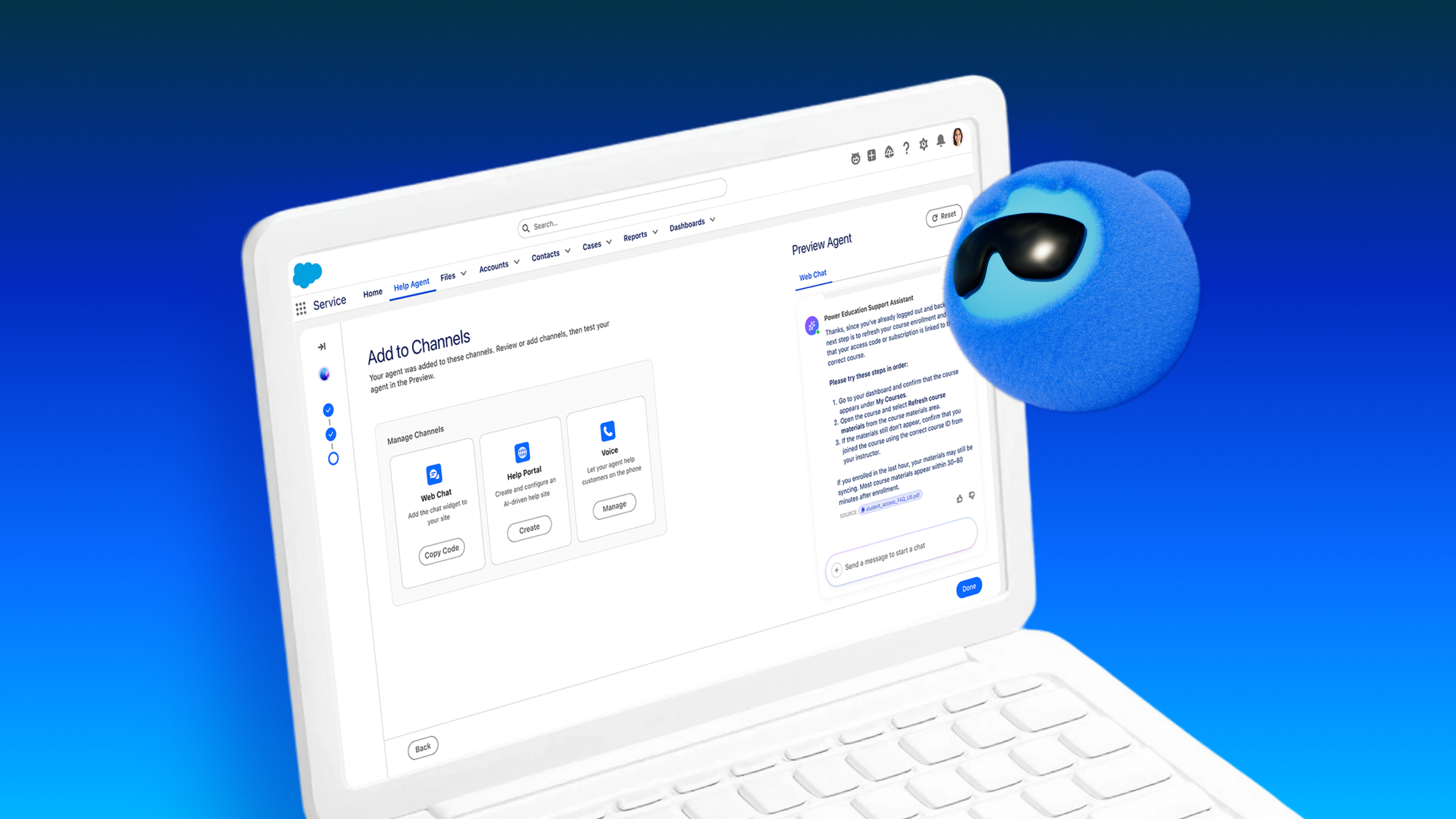
SAN FRANCISCO, Calif. - Salesforce has launched Agentforce Help Agent, a prepackaged autonomous service agent intended to reduce the setup work required for customer support automation. The enterprise software giant, headquartered in San Francisco, is positioning the new tool as a streamlined entry point for companies looking to integrate generative artificial intelligence into their customer experience infrastructure without the high barrier of custom engineering. By offering a solution that includes guided configuration, the company aims to address a persistent pain point in the enterprise sector: the complexity of deploying sophisticated AI that can handle multi-step customer inquiries across various digital environments.
The product is designed to operate seamlessly across web, portal, messaging, and voice channels without requiring each customer to assemble the workflow from the beginning. This omni-channel approach is significant in the current customer service landscape, where consumers often transition between different platforms and expect a consistent history of their inquiry. By centralizing the logic of the help agent, Salesforce is attempting to eliminate the siloed automation that has historically plagued large-scale customer service departments. The move comes as competitors in the cloud and customer relationship management space race to provide more 'out-of-the-box' functionality for autonomous agents.
Technically, the agent connects directly to a company's internal knowledge base and approved actions to resolve issues from start to finish. Unlike traditional chatbots that prioritize keyword matching or simple decision trees, the Agentforce Help Agent is built to execute tasks. If a customer needs to process a return or update an account detail, the agent is designed to navigate the necessary back-end steps based on the permissions it has been granted. This shift from informative AI to executive AI reflects a broader movement within Silicon Valley to move beyond simple chat interfaces toward agents that can perform meaningful work.
Salesforce has announced that the product can be deployed in minutes, a claim that underscores the company's focus on speed-to-market. The general availability for the Help Agent and its related customer portal is currently planned for July. This timeline puts the launch in the middle of a busy summer for enterprise software updates, as businesses evaluate their technology stacks for the second half of the fiscal year. The promise of rapid deployment is particularly attractive to mid-market companies that lack the massive IT implementation teams typically required for high-end automation projects.
One of the most notable aspects of the launch is the shift in billing strategy. Salesforce will charge by successful resolution rather than by every individual message or model interaction. Outcome-based pricing addresses an increasingly common problem in the agent software market: the unpredictability of costs. With standard token-based or per-message charges, expenses can become difficult to forecast when an interaction requires repeated reasoning, multiple tool calls, or extensive background processing. By aligning the invoice with a business result, Salesforce is betting that transparency will drive higher adoption rates.
Analysts have noted that while charging for resolution aligns the costs with value, Salesforce will need a precise definition of what exactly counts as a 'resolved' case. The industry has long struggled with defining the end-point of an automated interaction, as a customer may leave a chat without their problem being solved, only to call back later. Establishing a fair process for disputed outcomes will be critical for maintaining trust between the platform provider and the enterprise customer. If a resolution is defined too loosely, customers may feel overcharged for incomplete assistance; if too strictly, the provider risks under-monetizing the technology.
The prepackaged nature of the Help Agent is a double-edged sword for the industry. On one hand, it can significantly speed up adoption for organizations that are eager to deploy AI but are currently stalled by the technical requirements of building custom models. On the other hand, the ease of setup can encourage customers to deploy the technology before their underlying knowledge base, permissions, and escalation rules are fully ready. Industry experts suggest that the effectiveness of any autonomous agent is only as good as the data it can access, making the readiness of a company's internal documentation a prerequisite for success.
Service leaders are being advised to test the agent on more than just routine questions. SiliconANGLE reports that because the Help Agent is capable of operating autonomously, it must be rigorously vetted against incomplete requests, policy exceptions, and emotionally sensitive situations. While an AI can easily provide a shipping status, its ability to handle a frustrated customer or a complex refund request that falls outside of standard operating procedures will be the true test of its sophistication. These 'edge cases' often represent the highest cost and highest risk interactions for a brand.
The ultimate success of the product will be measured by containment quality rather than raw automation volume. In the metrics-driven world of customer service, 'containment' refers to the ability of an automated system to handle an inquiry without human intervention. However, a fast answer that creates a repeat contact or triggers an incorrect action on a customer’s account is not a successful resolution. In fact, poor automation can often lead to higher costs in the long run if a human agent has to spend twice as much time correcting a mistake made by an autonomous system.
To make this model attractive to high-stakes industries like finance or healthcare, Salesforce will likely need to provide transparent transcripts and auditable actions. Enterprises require clear evidence that the agent is improving service and not merely hiding failures behind a billing label. The ability for human supervisors to jump into an audit trail and see exactly why an agent made a specific decision remains a top priority for compliance and quality assurance teams. This level of visibility is what separates enterprise-grade AI from general-purpose consumer chatbots.
The launch of the Agentforce Help Agent fits into a larger trend of 'agentic' workflows becoming the standard for enterprise software. As the high-level hype surrounding large language models begins to settle, the focus has shifted toward the practical application of these models in specific business verticals. Salesforce is leveraging its existing footprint in the service sector to solidify its position as a primary provider of these autonomous capabilities, hoping to preempt specialized startups that are targeting niche parts of the customer journey.
Looking ahead to the July release, the market will be watching to see how existing Salesforce customers integrate the Help Agent into their current Service Cloud workflows. Integration with existing data and its performance in real-world environments will determine if the outcome-based pricing model becomes a new industry standard. As enterprise budgets remain under scrutiny, the ability to demonstrate a direct link between software spend and customer resolution could give Salesforce a significant competitive advantage in the coming year.
The competitive landscape for this product includes major players such as Microsoft and Zendesk, both of whom have been aggressive in their pursuit of AI-driven service tools. However, Salesforce’s approach of a prepackaged, autonomous agent that charges per resolution represents a distinct strategy in a market where many are still experimenting with pricing tiers. If successful, this could force a broader shift in how enterprise software is valued, moving away from per-seat licenses toward a utility-based model focused on results.
Ultimately, the Agentforce Help Agent represents Salesforce's latest effort to simplify the 'first mile' of AI adoption. By lowering the technical and financial hurdles to deployment, the company is positioning itself as an essential partner for firms navigating the transition to automated service. The coming months will reveal whether the tool's performance can live up to its promise of rapid deployment and high-quality resolution, or if the complexities of human service will continue to require a more customized, hands-on approach.
Sources
Written by
The Company Wire
Inside the companies building what’s next. Reporting on startups, technology, funding and the people shaping them.