Meta Unveils Muse, an Autonomous AI Agent Designed for Complex Digital Tasks
The social networking giant is introducing a proactive personal assistant capable of online shopping, drafting correspondence, and managing third-party app integrations.
Meta Platforms Inc. has revealed Muse, an autonomous artificial intelligence agent designed to carry out complex personal tasks ranging from travel planning and email composition to executing online retail purchases. The company stated that the new software requires no technical experience to set up and operate.
The software marks a major operational leap beyond Meta's existing conversational assistant, featuring dedicated mobile applications alongside a standalone website. Built to operate independently once provided with a broad objective, Muse is designed to execute multi-step workflows without continuous human intervention. "Once a person shares a goal with Muse, it helps them develop a personalized plan and coordinate their time and resources, then advances the work on its own," Meta explained in an official announcement.
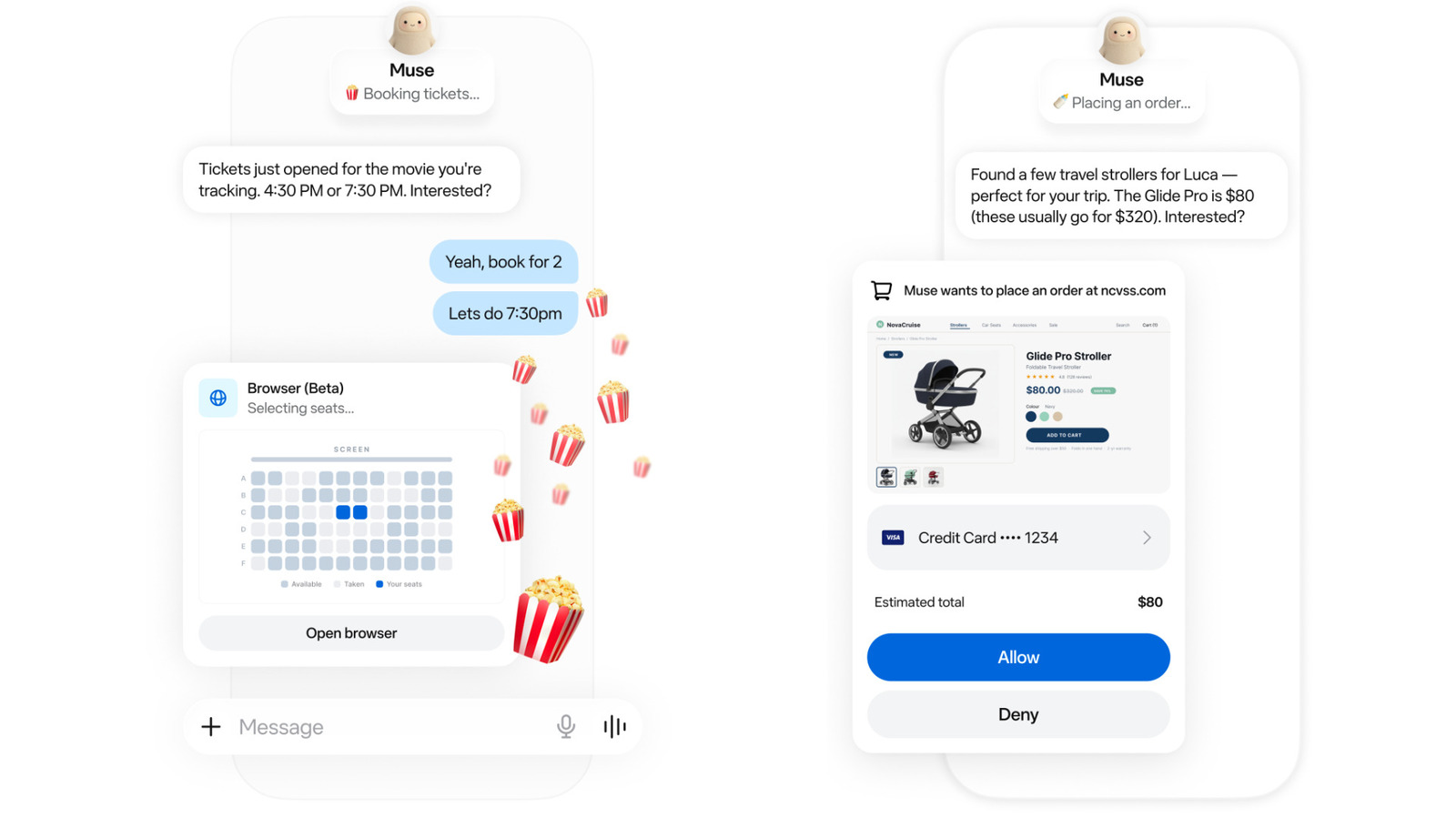
The scope of Muse's capabilities depends directly on the level of permissions granted by the user. The agent integrates with Meta's native social ecosystem—including Facebook and Instagram—as well as external digital services such as Google Workspace, Ticketmaster, OpenTable, Spotify, and Apple Health. In practice, a user could direct Muse to scan saved culinary videos across Meta's platforms, reformat the instructions into a structured document, curate a grocery list, evaluate price variations across retailers, and place the final order.
In addition to pre-configured integrations, Muse can independently establish technical connections to outside services whenever a public application programming interface (API) is accessible. Speaking to Engadget, which first reported the launch, Meta Vice President of AI Products Vishal Shah explained that the tool's software-generation capabilities significantly broaden its utility. "Because it is a very capable AI product that can also build its own software, it isn't really limited in what it can do," Shah said. He added that maximizing performance requires users "to get more and more comfortable with giving it access to more, and also telling it what's important to you, so it can be the most helpful it can be."
To address security and data protection concerns inherent in granting autonomous software deep system access, Meta has implemented a tiered permission structure alongside isolated computational infrastructure. Each user's agent operates within a dedicated virtual machine, segregating user data environments from other accounts on Meta's network. Operationally, Muse is programmed to request explicit user approval before completing high-stakes actions like finalizing purchases or transmitting emails, while handling routine, lower-risk tasks without manual signoff.
Meta acknowledged that the autonomous system will inevitably experience technical errors, noting in a company blog post that "Muse can and will still make mistakes, but we expect they'll be much less frequent and cause much less damage due to the safety systems we've built in." The initiative forms a key element of Chief Executive Officer Mark Zuckerberg's strategy to deliver proactive AI agents to consumers as part of a broader push toward "superintelligence." Beyond its standalone web and mobile applications, Meta plans to integrate Muse into WhatsApp and its smart glasses to support mobile user interactions.
The launch comes as Meta seeks to navigate consumer trust following recent privacy controversies surrounding its AI-enabled smart glasses and a retracted feature that allowed users to generate synthetic images from public Instagram content. To mitigate privacy concerns with Muse, Meta allows individuals to opt out of having their interaction data used to train future foundation models. The company also stated that conversational logs will not be directly shared with advertising systems, though commercial activities such as product searches and shopping may indirectly affect ad delivery.
Meta has not outlined full details regarding monetization or subscription requirements for the service. The company stated that primary functionalities will remain free for general users, but noted that customers seeking to perform higher-volume or more complex tasks will eventually be required to pay for a Meta AI subscription.
Sources
Written by
The Company Wire
Inside the companies building what’s next. Reporting on startups, technology, funding and the people shaping them.