Scout AI Raises $100 Million to Develop Autonomous Systems for Defense
The startup is training a foundation model called Fury to control unmanned vehicles across changing military environments.
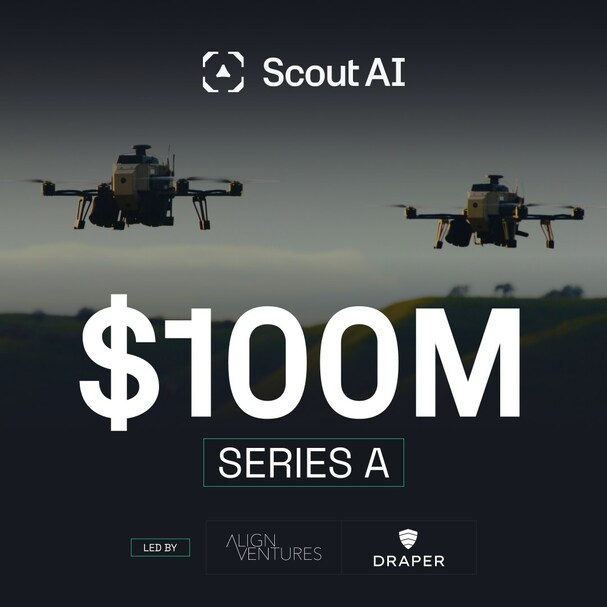
SUNNYVALE, Calif. - Scout AI has raised $100 million in Series A financing to develop artificial intelligence for unmanned defense systems, marking one of the most significant recent investments in the burgeoning intersection of Silicon Valley software and national security. Align Ventures and Draper Associates co-led the round, providing the Sunnyvale-based company with the necessary capital to expand its engineering team, bolster its intensive training infrastructure, and accelerate field deployments. The funding arrives as the global defense landscape shifts toward decentralized, autonomous assets, creating a robust market for startups capable of bridging the gap between legacy hardware and modern machine learning.
The startup is building Fury, a foundation model intended to control different classes of autonomous vehicles, ranging from aerial drones to ground-based robotics. Traditionally, autonomous military systems have relied on rigid, rules-based programming designed for specific, predictable environments. Scout's goal is to replace these narrowly programmed systems with generalized software that can adapt to unfamiliar terrain, incomplete information, and rapidly changing mission requirements. By utilizing a foundation model approach—similar to the large-scale architectures powering generative AI—Scout aims to move beyond brittle code toward a more resilient, adaptive intelligence capable of real-time reasoning in the field.
The Series A financing reflects a broader trend in venture capital where investors are increasingly comfortable backing 'defense tech' companies that once struggled to bridge the 'valley of death' in government procurement. With Align Ventures and Draper Associates leading the round, the infusion of $100 million suggests a high degree of confidence in Scout's technical roadmap. This capital will be primarily directed toward the significant compute costs associated with training Fury, as well as the specialized personnel required to fine-tune these models for high-stakes environments where failure carries extreme consequences.
Defense agencies are seeking autonomous systems that can operate when communications are unreliable and human supervision is limited, a set of conditions often referred to as 'contested environments.' In modern conflict scenarios, electronic warfare and signal jamming can render remotely piloted vehicles useless. Scout’s emphasis on onboard, localized intelligence aims to provide vehicles with the internal logic to complete objectives even when severed from a central command link. This shift toward edge-computing autonomy is viewed by many industry analysts as a critical requirement for next-generation defense architecture.
A reusable model like Fury could fundamentally alter the economics of defense manufacturing by reducing the need to engineer separate, bespoke software for every new vehicle class. Historically, every new unmanned platform required its own dedicated software stack, leading to fragmented ecosystems and enormous maintenance costs. Scout’s approach suggests a future where a unified software intelligence could be ported across diverse hardware. It could also allow improvements learned by a single vehicle on one platform to transfer across a broader, heterogeneous fleet, creating a collective learning effect that accelerates the refinement of autonomous behaviors.
The technical hurdles facing Scout AI and the Fury model are substantial, particularly regarding the reliability of foundation models in adversarial settings. Unlike consumer AI, where an error might result in a factual inaccuracy, a failure in a defense context could lead to catastrophic mission failure. Military autonomy must be exceptionally reliable under pressure, deeply resistant to adversarial manipulation or 'spoofing' by enemy actors, and governed by clear human controls to remain within acceptable operational bounds. Ensuring a stochastic model behaves predictably is one of the primary challenges Scout must address during its testing phase.
Policy and ethical considerations also loom large over the development of such systems. As Scout prepares for wider deployments, it must navigate the rigorous regulatory frameworks governing autonomous weapons and military software. The company will need to demonstrate that its software maintains a 'human-in-the-loop' or 'human-on-the-loop' capability, ensuring that ethical guidelines regarding the use of force and autonomous decision-making are strictly observed. For many observers, the transition from automated tools to truly autonomous agents represents a shift that requires unprecedented transparency.
Beyond the technical and ethical challenges, Scout must also prove that a general model can meet the performance and safety standards of specialized systems while surviving lengthy defense procurement cycles. The Department of Defense has historically moved at a pace that is often at odds with the rapid iteration cycles of Silicon Valley startups. However, recent initiatives to modernize acquisition processes suggest a growing appetite for commercially developed software. Scout’s ability to secure integrated contracts will depend on its ability to demonstrate that a general-purpose foundation model can outperform specialized, legacy software in head-to-head field evaluations.
The competitive landscape for Scout AI includes both established defense contractors and a new wave of well-funded AI startups. Traditional aerospace giants are increasingly investing in their own internal software divisions, while other venture-backed firms are exploring similar autonomous capabilities. Scout's focus on a unified foundation model, rather than specific hardware-software bundles, positions it as a potential horizontal layer in the defense stack. This strategy allows the company to partner with various hardware manufacturers, potentially avoiding the capital-intensive process of building its own vehicle fleet.
The Series A gives the company the resources to train larger models and test them with customers in realistic settings, moving beyond the laboratory and into the complex physical world. Development will likely involve extensive simulation-based training, where the Fury model can encounter thousands of edge cases that would be impossible or dangerous to replicate in physical tests. These simulations are essential for building the initial weightings of the foundation model before it is refined through real-world feedback loops and hardware integration.
Industry analysts note that future progress for Scout will be measured by field performance, not demonstrations alone. While high-impact simulations and controlled tests are necessary first steps, the true test of the Fury architecture will be its ability to handle 'black swan' events—unexpected scenarios that were not present in the training data. The ability of the software to maintain goal-oriented behavior during environmental shifts or sensor degradation will be the primary metric by which defense customers judge the system's readiness for active service.
If Fury can control multiple platforms safely and effectively, Scout could become an important software supplier as defense organizations globally expand their use of unmanned equipment. The total addressable market for autonomous systems is expected to grow as military strategies increasingly favor 'mass'—large numbers of relatively inexpensive autonomous units—over a small number of extremely high-cost manned assets. In this future, the value of the defense contract shifts from the steel and engines of the vehicle to the sophisticated software that directs its actions.
Looking ahead, the success of this $100 million investment will depend on Scout's execution over the next eighteen to twenty-four months. The company must deliver on its promise of a cross-platform, adaptive intelligence that can withstand the rigors of combat and the scrutiny of military auditors. As the defense industry watches closely, Scout AI represents a high-stakes bet on the idea that the same AI revolution transforming civilian life will eventually become the backbone of modern security operations, provided it can be tamed for the battlefield.
Sources
Written by
The Company Wire
Inside the companies building what’s next. Reporting on startups, technology, funding and the people shaping them.