Apple Extends Intelligence Across Maps, Find My and Apple Cash
The services update adds richer navigation, flexible location sharing, visual bill splitting and expanded media experiences.
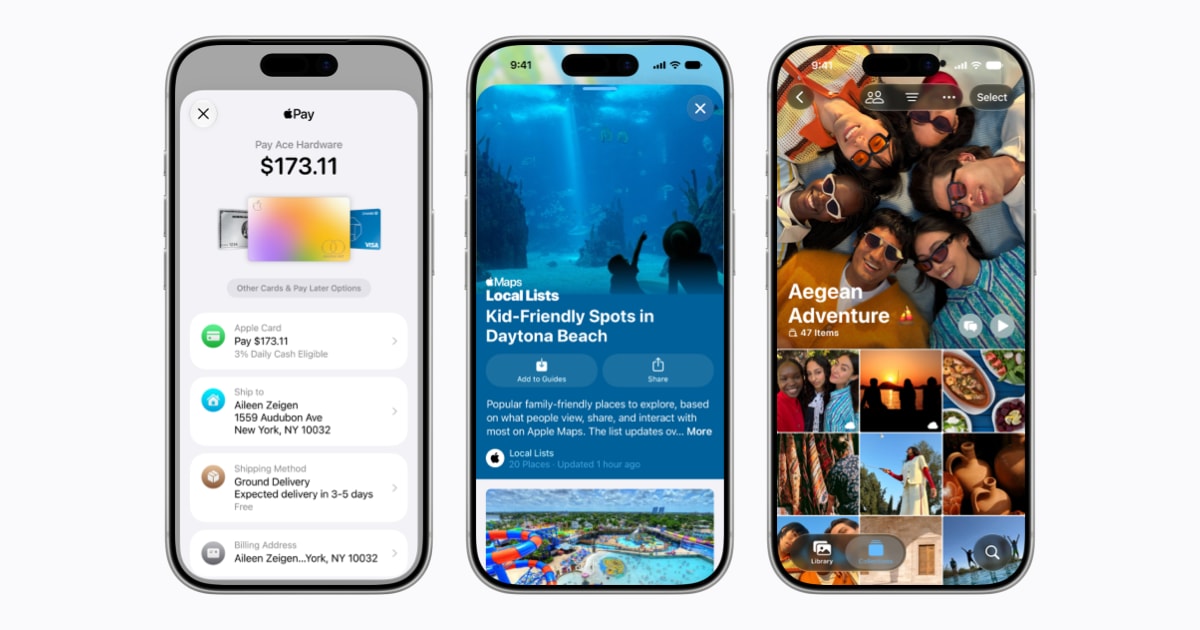
CUPERTINO, Calif. - Apple has previewed a collection of updates across Maps, Find My, Apple Cash, Podcasts, iCloud, and Fitness+ for its 2027 software releases, signaling a broader integration of machine learning and spatial awareness into its foundational ecosystem. The company is combining traditional service improvements with Apple Intelligence features intended to help users understand places, coordinate with contacts, and complete financial or media tasks. By weaving these tools into existing workflows, the tech giant aims to reduce the friction inherent in mobile multitasking, positioning its software as a more proactive partner in daily routines.
The updates arrive at a critical juncture for the consumer technology sector, where the conversation has shifted from standalone generative chatbots to the practical application of large models within utility applications. Apple has historically prioritized a vertical integration strategy, and these upcoming releases represent an effort to ensure that artificial intelligence feels less like a separate novelty and more like a core component of the hardware-to-software experience. Analysts have noted that this approach allows Apple to capitalize on its high user retention rates while defense-testing new features against competitors in the fintech and navigation spaces.
Within the navigation domain, Maps will gain improved Flyover views and Local Lists for organizing places. These enhancements suggest a continued push toward high-fidelity visualization, providing users with more immersive ways to explore urban environments before they arrive. The Local Lists feature represents a subtle but important shift toward social utility, allowing for better curation and categorization of points of interest. As the digital mapping market becomes increasingly competitive with the rise of AI-augmented search, these updates are designed to keep users within the Apple ecosystem for discovery as much as for turn-by-turn directions.
Coordination and safety also see a significant shift as Find My adds more flexible sharing options. These changes arrive as location-based services become standard for families and friend groups, requiring a balance between constant connectivity and granular privacy controls. Industry observers suggest that by making sharing more adaptable, Apple is responding to long-standing user requests for more nuanced visibility settings, allowing for temporary or situational location access that can be toggled without navigating deep into system menus.
Perhaps the most direct application of the company's new AI capabilities is found in the financial services sector. Apple Cash will use Visual Intelligence to recognize a bill and help a group divide the amount, reducing the steps required to calculate and request individual payments. By leveraging the camera and on-device processing to parse physical or digital documents, the service moves into the territory of popular third-party payment apps. This visual bill-splitting functionality highlights the company's desire to own the entire transaction stack, from receipt recognition to the final peer-to-peer transfer.
The push into multimedia services continues with Apple bringing video podcasts to Mac and Apple TV, expanding the reach of creators who have increasingly moved toward visual formats. This move reflects a broader industry trend where the lines between audio broadcasting and traditional television continue to blur. By standardizing the video podcast experience across the desktop and the living room, Apple is strengthening its position as a primary distributor of long-form digital content, ensuring that its hardware remains the preferred viewing platform for modern media.
Cloud storage and collaborative media also receive attention through a redesign of Shared Albums in iCloud. This update is expected to streamline how users organize and view collective memories, addressing long-standing pain points regarding album management and photo synchronization. As personal data grows in volume, the efficiency of managing large shared libraries becomes a key differentiator for cloud service providers seeking to prevent user churn to rival platforms.
Rounding out the software preview is a new program for Fitness+, as the company continues to invest in the health and wellness vertical. The additions to the subscription service underscore Apple's commitment to using its wearable and mobile hardware as a gateway to recurring revenue. By iterating on fitness content, the company targets a high-value demographic that overlaps heavily with its core iPhone and Apple Watch customer base, reinforcing the interconnected nature of its product categories.
The changes are scheduled to arrive with Apple's fall software releases, so availability will depend on device compatibility, region, and the final versions of each operating system. This staggered rollout is typical for the Cupertino firm, as it ensures that the newest features are optimized for the latest silicon and sensor arrays. However, the reliance on high-performance on-device processing may mean that some intelligence-heavy features are restricted to more recent hardware models, a common limiting factor in the deployment of advanced mobile AI.
This strategy shows Apple spreading intelligence through existing services rather than concentrating it in one assistant. That can make AI feel less intrusive because the model appears at the moment a task is already happening. This contextual integration is a departure from the 'one-size-fits-all' LLM interface, focusing instead on utility where it is most needed—whether that is in a financial transaction or a navigation search. Market observers have previously identified this as a way to mitigate the 'uncanny valley' of AI assistants by giving users specific, predictable tools.
Despite the potential for improved efficiency, this distributed approach makes reliability difficult to evaluate because users may encounter different model behavior across finance, navigation, media, and sharing. Because each service utilizes intelligence in a unique context, the benchmarks for success are not uniform. A minor error in a podcast recommendation is a vastly different user experience than a hallucination in a financial calculation or a navigation error. Maintaining a consistent standard of accuracy across these disparate domains remains a central challenge for the engineering teams.
Apple must be especially careful when visual recognition leads to a payment request or location-sharing action. These high-stakes interactions involve personal capital and physical safety, areas where errors are not easily forgiven by the consumer. Industry analysts have pointed out that as automation becomes more embedded in sensitive tasks, the margin for error shrinks. For Apple, which has built its brand on 'it just works' reliability, any systemic failure in these new intelligent features could carry significant reputational risk.
Users need a clear confirmation step and an easy way to correct extracted information to ensure transparency. The design of these interfaces will play a crucial role in whether the help is perceived as beneficial or burdensome. If the system incorrectly identifies a total on a bill or misinterprets a location tag, the user must be able to override the intelligence intuitively. Ensuring that the human remains 'in the loop' is essential for maintaining trust in automated systems that manage private data.
The update will be valuable if it removes repetitive work while keeping control visible, effectively acting as an invisible assistant that accelerates the user's intent. The goal is to eliminate the 'copy-paste' fatigue of manual data entry between apps. Shortening the distance between seeing a bill and paying it, or seeing a place and saving it, aligns with Apple's long-term goal of increasing the utility of its devices without increasing the amount of time users must spend staring at their screens.
Conversely, the updates will be frustrating if automation hides errors behind a polished interface. If the aesthetic of the software obscures the underlying logic of the AI, users may find themselves dealing with the consequences of automated mistakes before they even realize they occurred. As Apple moves toward its 2027 software cycle, the focus will likely remain on whether these intelligent services can deliver on their promise of seamless convenience without sacrificing the precision that its massive user base has come to expect.
Sources
Written by
The Company Wire
Inside the companies building what’s next. Reporting on startups, technology, funding and the people shaping them.